
The oak behind the Hollisters’ place had been part of the backyard longer than they had owned the house. It shaded the deck, held a rope swing for a couple of summers, and dropped acorns on the roof every fall. Then, over two or three seasons, it started to die. The leaves came in thin at the top, whole limbs went bare, and the trunk took on a slow lean that pointed straight at the back bedrooms.
By the time they started calling around, it was not a small problem anymore. This was a tall, heavy tree, dead enough to be unpredictable, and it hung right over the roof of their Keene home. The open ground that a normal removal needs was simply not there. On one side sat the house. On the other, a fence line and the neighbor’s garage.
Three companies came out to look. The Hollisters told us that each crew walked the yard, looked up, looked at the house, and got quiet. A couple of them talked through climbing it and lowering the limbs by rope. Nobody seemed comfortable. One of them said out loud what the others were thinking, which was that a piece coming down wrong would land on the roof.
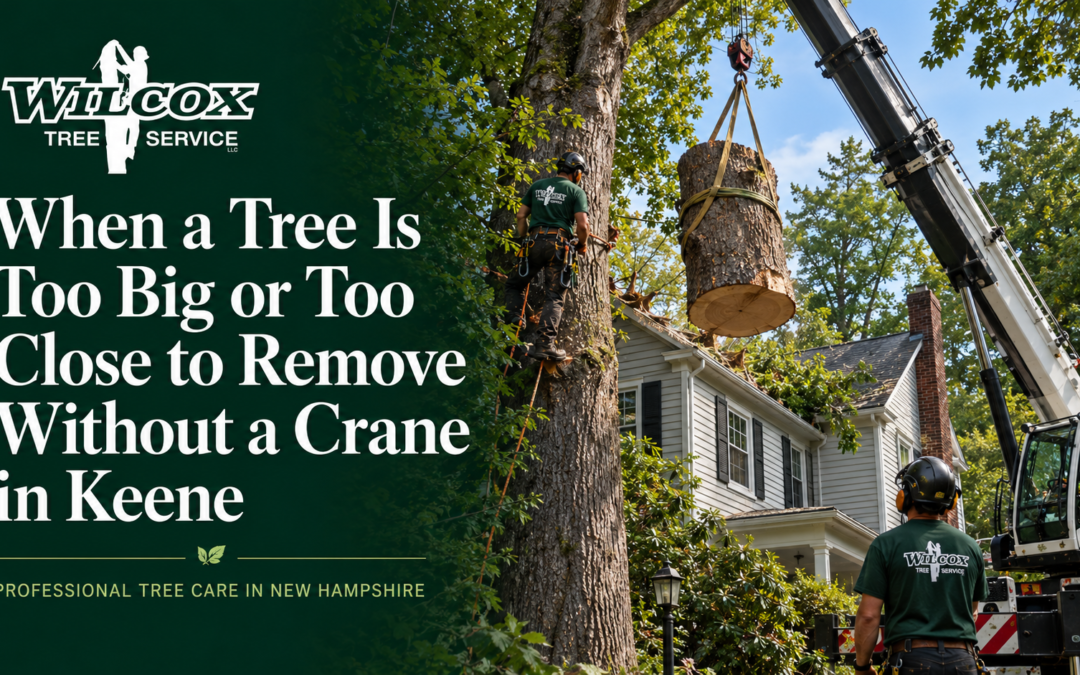
The crew that finally solved it did not climb the tree at all. They brought in a crane, set up out near the front of the property, and reached over the house. Someone went up just long enough to set the rigging, and from there the tree came out in sections, each one lifted up and away from the roof and swung down to the driveway. The house was never under the wood.
Start to finish, the part everyone had been dreading took a single morning. No branch ever touched the shingles. The job three other outfits had backed away from turned out to be a fairly routine day, once the right machine was doing the heavy lifting.
We see this kind of standoff across Keene more often than you would think. A tree gets too big, too dead, or too boxed in for the usual approach, and good intentions are not enough to make it safe. So here is how to tell, before you are standing in the yard staring up at it, when a tree has crossed the line from a standard removal into a job that really needs a crane.
The Trees That Standard Removal Cannot Safely Handle
Here is the short answer, since it is probably why you are reading. A tree needs a crane when its size, its lean, or its surroundings make it unsafe to take down piece by piece the normal way. That covers three big situations. Trees so tall and heavy that lowering limbs by rope puts too much load in the wrong places. Trees leaning over a house, garage, pool, or driveway, where a dropped piece has nowhere safe to go. And tight lots where there is simply no open ground to fell the tree or stack what comes down.
A standard removal works by having a climber move up through the tree, cutting limbs and sections and lowering them under control with ropes and rigging. On most trees in most yards, that is exactly the right method, and it is what a good standard tree removal in Keene looks like. It is safe, it is efficient, and it does not need heavy machinery.
The trouble starts when the tree is too big for the rigging to handle gently, or when there is no clear space beneath it to catch the pieces. Rope-lowering a heavy section still means that section swings and drops, even if only a few feet. Over open lawn, that is fine. Over a bedroom, it is a gamble nobody should take. When the margin for error shrinks to almost nothing, dropping wood is the wrong tool, and lifting it becomes the safe one.
Why Size and Position Change Everything in Keene
Two trees can look about the same from the street and be completely different jobs. What changes the math is not just how big the tree is, but where its weight sits and what is underneath it. In a region like ours, where older homes sit close to mature trees and lots back up against woods and stone walls, position matters as much as size.
Wood is heavy, and it does not get lighter as it goes up. A single upper limb on a mature maple or oak can weigh far more than most people guess, and once it is moving, that weight wants to keep going. The higher and heavier the piece, the more force runs through the ropes, the rigging point, and the tree itself when you try to lower it. Add a target below, like a roof or a fence, and the room for a mistake disappears. That combination, heavy wood over something you cannot afford to hit, is the heart of why some trees need a crane.
Massive Trees Over Structures
The clearest case is a big tree leaning or growing straight over a building. Roofs, garages, sheds, decks, and pools all fall into this group. When the trunk or the heavy limbs sit above a structure, every piece you cut has to be controlled from the moment it is free, because there is no safe place below to let it fall.
Rope-lowering can manage a lot, but it has limits. A heavy section still swings on the rope, and it still shock-loads the rigging when it catches. On a tree that is already dead or weakened, the anchor points you would rig from may not be sound enough to trust with that load. A crane changes the order of events entirely. The weight is held from above before the cut is finished, so the piece never drops and never swings toward the house. It lifts straight up and away instead.
For a tree hanging over a Keene roof, that difference is the whole game. Instead of hoping a heavy limb behaves on the way down, the crane simply carries it out over the house and sets it down in a clear spot, well away from the fall line.
Tight Lots With No Drop Zone
The other common situation has nothing to do with the tree being unusually huge. It is about the space around it. Plenty of yards in and around Keene are tight, with the house on one side, a fence or a wall on another, and a neighbor’s property just past that. A tree can be an ordinary size and still be nearly impossible to fell or lower, simply because there is nowhere for anything to go.
When there is no drop zone, a climber lowering pieces by rope runs out of room fast. Each section has to be small enough to swing into a shrinking gap without clipping the house, the fence, the garden, or the power service. That means more cuts, more time in the tree, and more chances for something to go wrong. On a crowded lot, patience alone does not fix the problem, because the problem is that the ground is full.
A crane borrows the airspace instead of the ground. Set up in the one open spot, often the driveway or the street side, it can reach over everything in the way and pull each piece up and out through the air. The tight yard stops being a trap, because the wood leaves from the top rather than fighting its way down through the only gap.
What a Crane Does That Climbing and Felling Cannot
It helps to picture what actually happens on a crane job, because the machine does something a rope and a saw simply cannot. In a standard removal, gravity is always working against you. Every piece wants to fall, and the crew’s job is to slow it down and steer it. A crane flips that around. It holds the weight up before the cut is made, so the piece is already supported the instant it comes free.
The sequence looks like this. The crane sets up on solid, level ground with its outriggers down and pads under them to spread the load. A crew member goes up, either on a line or in a bucket, and attaches the crane’s cable to the section that is coming next, choosing a balance point so the piece hangs level. The crane takes up the tension. Then the cut is made. The section lifts away cleanly, swings out over the house or the fence, and comes down to a landing zone where the ground crew takes it apart and clears it.
The gains are real and they stack up. Fewer pieces are dropped, which means less shock load on everything and far less risk to whatever sits below. The person aloft spends less time in the tree and makes fewer high-risk cuts. Big, heavy sections that no rope should be trusted with get carried out whole. And the work goes faster, because the crane does in one clean pick what would otherwise take many careful, nerve-wracking lowers.
This is the kind of work our own crew handles in-house. Wilcox Crane Service runs its own crane and trains its people to work around it, so a big or awkward tree does not turn into a hunt for an outside operator who has never seen the site. When you call us about a crane-assisted tree removal in Keene, the machine and the hands that run it come from the same team, which is exactly what a delicate lift over a roof calls for.
Signs Your Keene Tree Job Needs a Crane
You do not need to know rigging to get a good sense of whether your tree is a crane job. A homeowner can read most of the signs from the ground. Here is a plain checklist to run through before you even make the call. If several of these ring true, there is a good chance a crane is the safe answer.
The tree hangs over your house or another structure. If the trunk or the big limbs sit above a roof, garage, deck, or pool, there is no clean place to drop pieces, and lifting them out is usually the safer route.
There is no open ground under the tree. Look for the drop zone. If the space below is filled with the house, the fence, a patio, a pool, or garden beds, a climber has nowhere to lower wood, and the airspace above becomes the only clear path.
The tree is very tall, very heavy, or top-heavy. Big mature oaks, maples, and pines carry serious weight up high. When the bulk of the tree is well above the roofline, rope-lowering that weight gets risky in a hurry.
The tree is dead, storm-damaged, or leaning. A tree that has lost its strength cannot always be trusted as an anchor for climbing and rigging. A lean toward a building only sharpens the problem. Holding the weight from above sidesteps a compromised trunk.
The only open space is the driveway or the street. If the one clear, level spot on the property is away from the tree, that is often the perfect place to set a crane and reach over everything in between.
A previous company hesitated or turned the job down. This is the one the Hollisters learned firsthand. If a crew looked at your tree and got uneasy about dropping it, that uneasiness is information. The job may simply be built for a crane.
None of these signs require a tape measure or a trained eye. If you are nodding along to more than one, let someone who does this work take a look and tell you honestly which method fits.
How Wilcox Crane Service Handles Big Tree Removals in Keene
When you reach out to us about a big tree in Keene, the first thing we do is come look at it, not book a machine sight unseen. A crane job lives or dies on the setup, so we start by reading the site. Where can the crane sit so the ground can take the load. What is the reach to the tree, and how heavy are the pieces coming out. Where is the landing zone, and what has to be protected on the way there. We study the tree itself too, checking how sound it is and where the safe rigging points are.
From that walk-through we build the plan. We work out the order of the picks, the balance point for each section, and the path every piece will travel from the tree to the ground. We plan around the things that matter to you, like the roof, the garden, the driveway surface, and the power service, and we set down ground protection where the crane and the wood will land. Nothing about it is improvised on the day.
On the job, the lifts themselves are calm and deliberate. One crew member sets the rigging on the next section while the ground team keeps the landing zone clear and the operator runs the crane. Piece by piece, the tree comes out over the house and down to the drop spot, where it gets cut down and loaded out. Because the weight is always supported, there is no crash and nothing swinging toward the building.
Then we clean up like it was our own yard. The wood goes, the debris gets cleared, and we walk the property with you at the end so you can see that the lawn, the fence, and the roof all came through fine. Our aim is simple. You started the day with a tree you were worried about, and you should end it with the tree gone and everything else right where it was.
A big tree does not have to become a big risk, and you do not have to guess about it on your own. Have a big or awkward tree in Keene? Call Wilcox Tree Service at 603-903-8624 to see if a crane is the safe answer.
Frequently Asked Questions
- When does a tree in Keene need a crane to remove it?
A tree usually needs a crane when its size, its lean, or the space around it makes dropping pieces by rope unsafe. The common triggers are a heavy tree hanging over a house or other structure, a tree that is dead or leaning so its trunk cannot be trusted for climbing, and a tight lot with no clear ground below to lower wood into. When any of those apply, lifting each section up and away is safer than letting it fall.
- Is crane removal safer for a tree leaning over my house?
In most cases, yes. A tree leaning over your house is exactly the situation a crane is built for. Instead of hoping a heavy limb swings the right way as it is lowered on a rope, the crane holds the weight from above and carries each piece up and out, so the roof is never in the fall line. On a tree that is dead or weakened, it also means the crew is not depending on a questionable trunk to anchor the rigging. The house stays out from under the wood the whole time.
- Can a very large tree be removed from a small Keene yard?
Often, yes, and the crane is usually the reason it is possible. A small yard is a problem because there is nowhere to fell the tree or lower pieces without hitting something. A crane gets around that by working through the air rather than the ground. Set up in the one open spot, frequently the driveway or the street side, it reaches over the fence, the house, and the garden and pulls each section straight up and out. The tight space that blocks a standard removal is exactly where a crane earns its keep.
- What makes a tree too big for a standard removal?
It is less about a single measurement and more about weight in the wrong place. A tree becomes too big for a standard removal when its heavy sections sit high up and over something you cannot afford to hit, so lowering that weight by rope carries too much risk. Height, total weight, a top-heavy shape, and a poor drop zone all feed into it. A tall, heavy tree over an open lawn might be a routine climb, while the same tree over a roof is a crane job. The surroundings decide as much as the tree does.
- Does Wilcox Tree Service have its own crane for tree removal in Keene?
Yes. Wilcox Tree Service runs its own crane and trains its crew to work with it, so the machine and the people operating around it come from the same team. That matters on a delicate lift over a roof, because the operator and the crew member setting the rigging already know how each other works. You are not waiting on an outside operator who has never seen your property. When a Keene tree calls for a crane, we bring our own and handle the whole job start to finish.
- How do I find out if my tree job needs a crane?
The easiest way is to have someone who does this work come look at it. You can spot many of the signs yourself, like a tree hanging over the house, no open ground beneath it, a heavy or leaning trunk, or a previous crew that seemed uneasy about dropping it. If any of those sound familiar, give us a call and we will walk the site, read the tree, and tell you honestly whether a standard removal will do or a crane is the safer choice.