
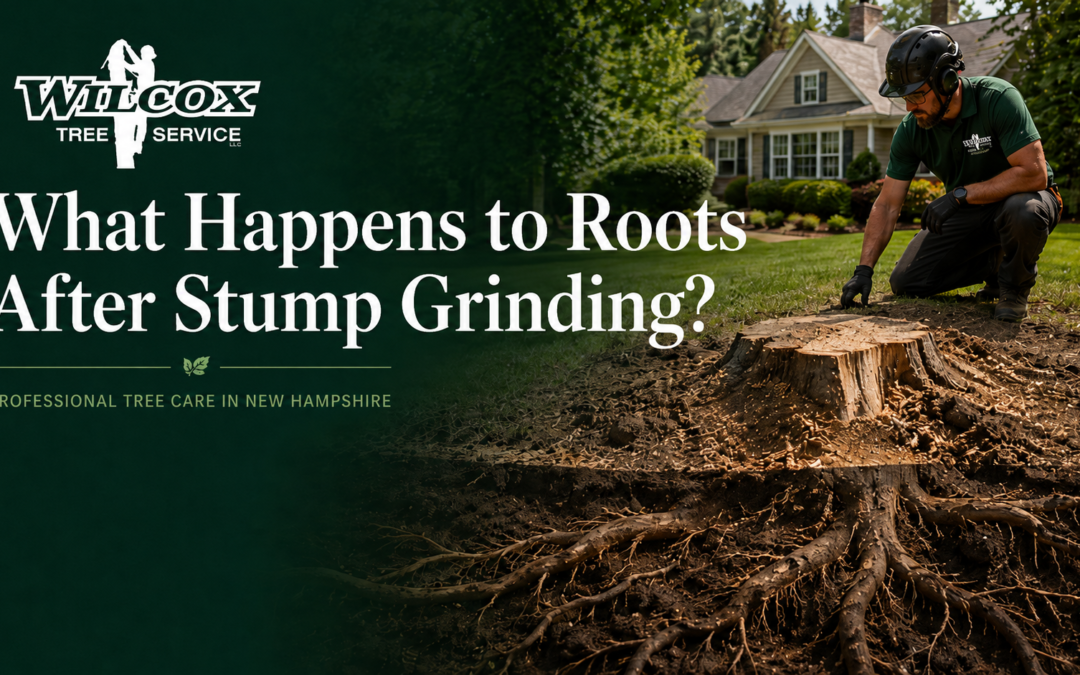
One of the most common questions about stump grinding is “what happens to all the roots?” Short answer: they stay in the ground and slowly decay. Longer answer: there’s more happening than that, and it’s usually good news. Here’s what Wilcox Tree Service wants homeowners to understand.
The Simple Answer
When a stump is ground, only the visible above-ground portion and the top 6–12” of the stump’s main mass are processed. The lateral roots (spreading horizontally) and the taproot (spreading vertically) remain in place underground.
What Happens to Those Roots Over Time
Immediately after grinding: – Roots are cut off from their food source (the stump and foliage) – Vascular flow stops – Roots begin to die
Weeks 1–12: – Rootlets (fine feeder roots) dry out and die quickly – Larger roots remain intact but no longer growing – Some moisture loss through cut surfaces
Months 6–24: – Decay organisms colonize the dead root tissue – Outer bark/cambium begins breaking down – Visible settling may occur where major roots were
Years 3–7: – Most lateral roots fully decayed – Major structural roots still visible if excavated but soft – Soil has largely reclaimed the root volume – Can be difficult to tell a stump was ever there
Years 7–15: – Taproot and deepest roots fully decayed – Location indistinguishable from surrounding soil
Is the Decay a Problem?
For most homeowners — no. The gradual breakdown: – Adds organic matter to the soil – Improves drainage – Creates channels that aerate the soil – Doesn’t attract new pests (once the stump is gone)
Some homeowners actually notice the soil quality improves in the area where old roots decayed.
Will Anything Grow Back from the Roots?
Generally no, once the stump is ground below grade. A few species that can resprout from root pieces: – Poplar – Willow – Ailanthus (tree of heaven) – Some sumacs
If you had one of these species, watch for shoots and cut any that appear — they’ll eventually give up without stored energy in a central stump.
Most common NH species (maple, oak, pine, birch, ash, hemlock) don’t resprout once the stump is fully ground.
Soil Settling and What to Do About It
As major roots decay, some settling occurs: – Near the stump: Settling is minimal because grindings filled that area – Along former lateral roots: 1–3” of settling over years as major roots break down – Over large taproots: Can be more significant settling over time
Most homeowners address this gradually by topdressing (adding soil) during normal lawn maintenance. If you’re noticing significant settling, we can advise on appropriate fill.
Lawn Over Decomposing Roots
Grass will grow over decomposing roots with no problem. You may notice: – Minor settling requiring occasional topdressing – Slightly faster decay beneath the grass (grass roots + bacteria speed the process) – No detectable impact on lawn health after 1–2 seasons
Planting Trees Near Old Stump Locations
If you want to plant a new tree in the general area: – Direct replant in same spot: Challenging — old root system will compete – 3–5 feet away: Works fine – 10+ feet away: No impact
Your new tree’s roots will find their own space without issue.
Planting Shrubs, Flowers, or Gardens
Same principles apply: – Right on top of old stump: Grindings mixed with soil creates loose growing medium – Over major root lines: Fine for most shrubs and perennials – Establishing a garden bed: Add topsoil for depth if needed
Underground Utilities and Roots
If the old tree had roots near water lines, sewer lines, or septic fields, those roots will decay eventually and remove root pressure from utilities. New trees planted in those areas may cause the same issue, so plan species and placement carefully.
The Bottom Line
For most residential stump grinding, the decaying roots are a non-issue. Over years, they quietly convert to soil without you noticing. If you have specific concerns (foundation proximity, utility lines, replanting plans), we discuss those during the estimate.
Schedule Stump Grinding
Call 603-363-8197 or request an estimate.