
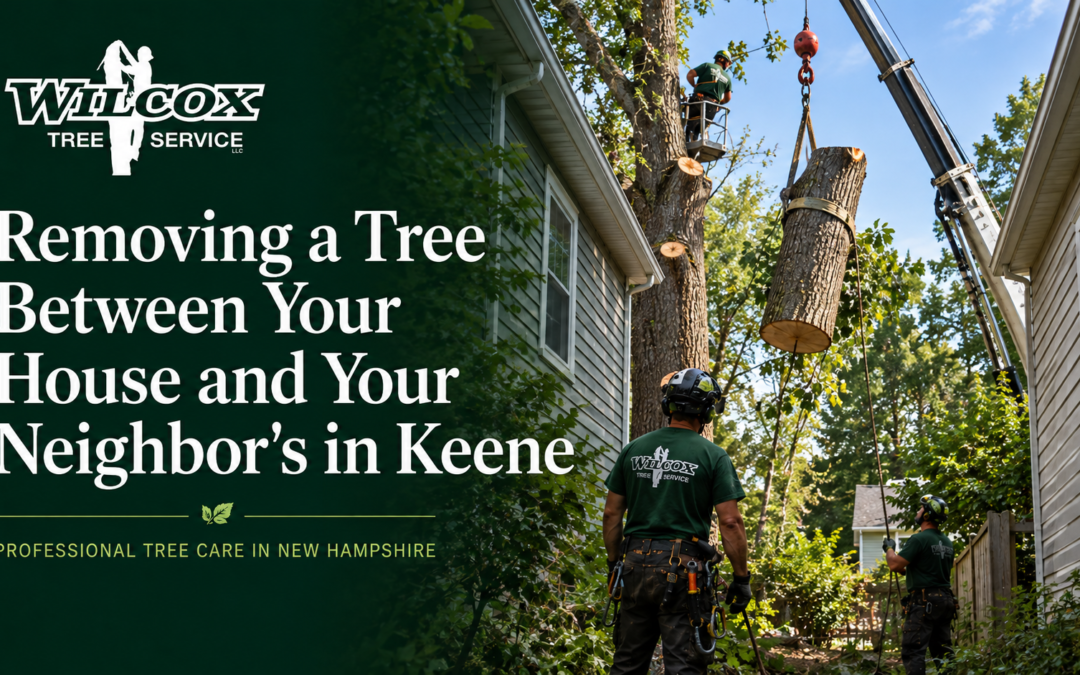
The blue spruce had been sick for two summers before Marisol Alvarez let herself say out loud that it was not coming back. It stood in the narrow strip between her Keene home and the Petersons’ place next door, close enough to both that years ago the two families had strung a badminton net from its lowest branch. Now the needles had gone brown, the bark was flaking off in sheets, and the whole tree had started to lean the smallest bit toward her neighbor’s bedroom window.
What kept her up at night was not that the spruce was dying. It was where it stood. There was maybe fifteen feet of grass between the two houses, and the tree sat almost dead center in that gap. Whichever way it finally let go, it was going to land on somebody’s roof.
She walked that strip a dozen times trying to picture how anyone would get it out. There was no open lawn to drop it into. No driveway wide enough to lay it down. Just two homes, a run of grass, a shared fence, and a tall dead tree wedged in the middle of all of it like a cork in a bottle.
A couple of the crews she called came out, looked at the spot, and went quiet. One floated the idea of climbing it and taking it down in little pieces over a couple of days, hand-roping every single limb. Another said it was a tough one, told her he would follow up, and never called back.
When she reached us, the first question our crew asked was about that gap. How wide was it, what sat on either side of the tree, where could a truck park on the street. Because for a tree with nowhere to fall, the answer is almost never to make it fall. It is to pick it up and lift it straight out over the roofs, in the one direction that is still open. Up.
The Property-Line Tree With Nowhere to Go
A tree standing right on the line between two houses is one of the trickiest removals there is, and the reason is plain. It has nowhere to go. On a normal lot, a crew can fell a tree into an open yard, or climb it and lower each piece into clear space below. A tree squeezed into a narrow gap between two homes has no clear space below it. Almost every direction ends at a roof, a wall, a fence, or a window.
So here is the short answer to how a tree like that comes out. You lift it, you do not drop it. A crane is set up in the nearest open spot it can reach from, usually the street or a driveway. The crew ties each section of the tree to the crane’s line, cuts it free, and the crane raises it straight up and over the houses to a truck waiting clear of both homes. Nothing falls. Nothing swings toward either roof. The weight travels up, which is exactly the point when down is where both houses are.
For a homeowner in Keene who has been told the tree is too tight to touch, that vertical lift is usually what changes the picture. The gap that made every ground-level method impossible does not matter to a machine that works in the air above it. The rest of this comes down to doing that lift carefully, and to sorting out the neighborly side of a job that touches two properties at once.
Why a Tree Between Two Homes Is So Risky to Remove
Most tree jobs put one property at risk, the owner’s own. A property-line tree doubles the math. There are two roofs in play, two sets of walls and gutters and windows, sometimes two porches and two chimneys, all sitting within a few feet of one trunk. A wrong move in either direction ends up on a house. That is what makes these removals a different kind of problem, not just a bigger version of a normal one.
Protecting Both Roofs at Once
On an open lot, a branch that gets away from a crew might clip a gutter or crack a section of fence, and that is the worst of it. In the gap between two homes, that same loose branch has a roof under it no matter which way it goes. There is no safe direction to miss into. Everything that comes off the tree has to be controlled from the second it is cut to the second it is down, because a slip toward either side is a slip toward a house.
The details add up fast, too. Skylights, solar panels, a chimney cap, a satellite dish, the neighbor’s new gutters, the customer’s own porch roof. All of it lives within a limb’s length of the trunk. We treat the neighbor’s house with the same care as the customer’s, because to a falling piece of wood they are the same short distance away and just as easy to damage.
No Room to Fell or Lower Freely
Felling the tree is off the table right away, since there is nowhere to aim it. But even the standard climbing method runs out of room here. When a climber takes a tree down in pieces, each piece still has to be lowered on a rope and swung clear of the trunk into open space before it is set down. That open space is the whole trick, and in a fifteen-foot gap with a house on each side, it simply is not there.
This is the wall homeowners keep hitting. A piece lowered by rope still has to travel somewhere on its way down, and every somewhere in that gap has a house in it. So the plans that do come back involve days of slow, careful hand work, or the crew simply passes on the job. The space itself is the obstacle, and no amount of clever roping makes the gap any wider than it is.
How a Crane Lifts a Tree Straight Up and Out
It helps to see how the vertical lift actually goes, step by step, because once you picture it the whole thing stops feeling impossible. The crane sets up in the one open spot it can work from, often the street out front or a driveway, sometimes the far side of one of the houses. Its boom reaches up, over the roofline, and lowers a line down to the tree in the gap.
Before any cut is made, a crew member ties the section that is coming off to the crane’s line. The line snugs up and takes the weight while the wood is still attached to the tree. Only then does the saw go to work. Instead of dropping, the cut section hangs from the crane, already held. The operator lifts it straight up, clears the roofs on both sides, swings it out over open ground, and sets it down next to the truck. Then the line comes back for the next piece. The crew works from the top of the tree down, taking the crown apart first and the trunk last.
The reason this works where nothing on the ground can is two things, reach and control. The crane’s boom reaches high enough to lift over a house, so it never needs the blocked ground on either side. And because every piece is held by the line before it is ever cut, nothing is left to fall on its own. The weight moves only where the operator sends it, in slow, deliberate lifts. That vertical lane over the roofs is the one path that stays open in a tight gap, and the crane is built to use it.
This is the kind of work our crane crew at Wilcox Tree Service does around Keene and across the Monadnock region all season long. A dead tree wedged between two houses is close to a worst case for any other method, and close to routine for a lift-out. If you want to read more about how it works, we go into it on our page for crane-assisted tree removal in Keene, but the short version is the one above. When the ground gives you no room, you go up.
Coordinating a Removal on a Shared Keene Property Line
The lift is only half of a property-line job. The other half is people. A tree that sits on the boundary almost always means the crane has to reach over, or set up beside, a house that does not belong to the customer. Branches may hang above the neighbor’s yard. The best spot to park the crane might be the neighbor’s driveway. None of that goes smoothly without a conversation first.
The question we hear most is who is actually responsible for a tree on the line. In general terms, when a trunk grows right on the boundary between two lots, it is usually treated as shared property, and both owners typically have a say in what happens to it. Sorting that out is a talk between the two neighbors, and now and then a quick look at a property survey, before any crew shows up. We are not the ones to settle a boundary question for you, but we are glad to work with both households once everyone agrees the tree is coming out.
The jobs that go the smoothest are the ones where both neighbors know the plan ahead of time. Where the truck will sit, which yard the crane needs, how long a slice of the street might be coned off, where the crew will be walking. A crane in a tight spot between two homes is a big presence for a morning, and a little notice keeps it from catching anyone off guard. When we set up a property-line removal in Keene, we walk both sides of the job with whoever needs to be in the loop, so the day runs on agreement instead of surprise.
How Wilcox Crane Service Handles Property-Line Removals in Keene
When a call comes in about a tree stuck between two houses, the first thing we do is come look at it in person. Photos only tell so much. We measure the real gap between the homes, look hard at both roofs, and figure out where the crane can set up, what its boom can reach, and how heavy each section is going to be coming off the tree. A tight, shared-line job lives and dies on that read of the site.
From there we plan the removal backward from the lift itself. Where the crane sits, what it can reach, which piece comes off first, where each section gets set down. On a dead or failing tree, that planning matters even more, because removing a hazardous tree in Keene means the wood may be brittle and unpredictable, and every cut has to be worked out before a saw ever runs. Nothing about a property-line lift is improvised.
On the day, the work is slow on purpose. We protect both properties, tie off and lift each piece up and out over the roofs, and keep the crown coming apart from the top down until the trunk is all that is left. Then we clean up. You should not trade a dangerous tree for a gap full of brush and sawdust, so we haul off the wood, clear the strip between the houses, and walk the finished site with you before we leave.
None of this is about pushing you into anything in a stressful moment. A property-line tree is a genuine worry, with two homes hanging in the balance, and our job is simply to get it out cleanly and leave both households better off than we found them. That is the whole aim, every time our crane crew rolls into a Keene neighborhood.
Have a tree wedged between two Keene homes? Call Wilcox Tree Service at 603-903-8624 for a safe lift-out.
Frequently Asked Questions
- How is a tree between two houses removed in Keene?
With a crane, in almost every case. A tree squeezed into the gap between two homes has no open ground to be felled into and no clear space to lower pieces onto, so instead of dropping it, a crew lifts it. The crane parks in the nearest open spot, usually the street or a driveway, and its boom reaches over the roofs. Each section is tied to the crane’s line, cut free, raised straight up, and swung out to a truck clear of both houses. The tree comes apart from the top down, and nothing is ever left to fall on its own.
- Can a crane remove a tree with no drop zone?
Yes, and that is exactly the situation a crane is built for. A drop zone is the open space a normal removal needs so pieces have somewhere to land or be lowered. A tree between two homes has no such space on the ground. A crane sidesteps the problem by working in the air, holding each section on its line before it is cut and lifting it up and over the houses instead of down. Because the weight is supported the whole way, the missing drop zone on the ground stops mattering. The open lane is overhead, and that is the one the crane uses.
- What happens if a property-line tree threatens both homes?
Then both roofs have to be protected as if each one were the customer’s, because to the tree they are the same short distance away. A loose piece in that gap has a house under it no matter which way it falls, so there is no forgiving direction to miss into. That is why a controlled crane lift is the safe way through. Every section is held on the line before it is cut and raised straight up, so nothing swings toward either home. When a single tree puts two houses at risk at once, taking the guesswork out of where the weight goes is the entire job.
- Who is responsible for a tree on the property line in Keene?
As a general rule, a tree whose trunk sits right on the boundary between two lots is treated as shared property, and both owners usually have a say in what happens to it. The specifics are a conversation between the two neighbors, and sometimes a look at a property survey, rather than something a removal crew decides. Our part starts once both households agree the tree is coming out. From there we are glad to work with both sides on access and timing, but the question of ownership itself is one for the neighbors to settle first.
- Does Wilcox Crane Service coordinate with my neighbor for access?
Yes. A property-line removal almost always touches the neighbor’s side, whether that means reaching the crane’s boom over their roof, setting up in their driveway, or clearing branches above their yard, so coordination is part of the job, not an afterthought. We walk both sides of the property with whoever needs to be involved, explain where the truck and crane will sit and how long the work will take, and make sure both households know the plan before the day arrives. The removals that go smoothest are the ones where nobody next door is caught by surprise.
- Is a crane the safest way to remove a tree between two homes?
For a tree wedged in a narrow gap, it usually is. The main danger in that spot is a piece of wood falling in an unplanned direction toward one of the houses. A crane removes that danger by holding every section on its line before it is cut and lifting it straight up and out, so no piece is ever left to drop or swing on its own. Compared with hand-lowering heavy wood in a space with no room to work, a controlled vertical lift keeps the load predictable from start to finish. That control is what makes it the safer choice between two homes.