
The Foleys had a backyard that a lot of Keene homeowners would recognize. Fenced on three sides, a neighbor’s garage close on the left, another family’s garden just past the fence on the right, and a big dead maple standing in the back corner where nobody could quite figure out how to reach it.
For a couple of years, everyone who looked at that tree told them the same thing. It was stuck. There was no gate wide enough for a truck, no clear path from the driveway to the back corner, and fences and flower beds boxing in every approach. One person suggested taking down a section of fence. Another figured the lawn would just have to get torn up and reseeded later.
So the Foleys did what most people do with a problem that looks unsolvable. They left it. The maple kept dropping limbs after every windy night, and they kept parking their worry right next to it, sure that getting it out would mean wrecking half the yard to save the other half.
When our crew finally came to take a look, nobody walked into that backyard with heavy gear. No machine rolling across the grass, no truck backed up to the fence line. Instead, we set up out on the street in front of the house.
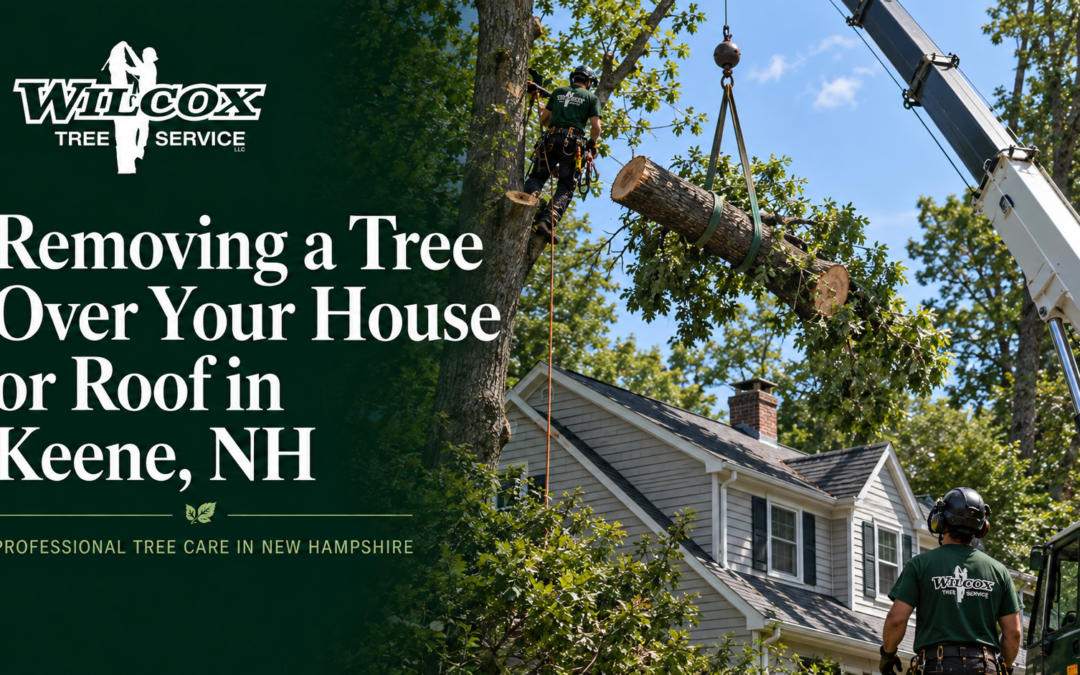
From there, the crane did the reaching. It lifted up over the roofline, out over the back of the house, and picked the dead maple apart in sections, carrying each piece up and out to the street instead of dragging anything through the yard.
The Foleys had braced themselves for ruts in the lawn and a fence panel leaning against the garage. What they got instead was their backyard back, grass and beds and fences all still where they left them. That is the part most folks do not expect, so let us walk through how a tree comes out of a closed-in Keene backyard without the yard paying for it.
The Backyard Tree Everyone Says Cannot Be Removed
Here is the short answer, since it is the thing most people want to hear first. A tree in a fenced-in, no-access backyard can almost always come out, and in most cases it comes out without anyone tearing down a fence or driving equipment across your lawn. The tree is not stuck. The old way of reaching it was just the only way people pictured.
When a removal looks impossible, it is usually because someone is imagining the job on the ground. Get a truck back there, drag the brush out through a gate, feed everything into a chipper parked next to the tree. If there is no room for any of that, the whole thing starts to feel like a dead end.
A crane changes the question completely. Instead of asking how we get equipment to the tree, we ask how we lift the tree out to the equipment. The work happens up in the air and out at the street, not in the tight corner where the tree is standing. That single shift is why “it cannot be removed” turns out to be wrong far more often than it is right.
We take calls like this across Keene every season at Wilcox Tree Service, and the answer is almost always the same. So for the rest of this piece, keep that idea in your back pocket. Most of the trees people assume are trapped are simply waiting for reach instead of access.
Why Tight Access Stumps Standard Crews in Keene
To understand why a crane helps, it is worth being honest about what actually goes wrong on a tight-access job when you try to do it the ordinary way.
Start with fences. A lot of Keene backyards are closed in on every side, and the gates are built for people and lawn mowers, not for trucks, chippers, or a lift. A fence that keeps the dog in also keeps every useful machine out. Taking a panel down is possible, but now you are rebuilding fence after the tree job is over, and the neighbor’s side may not come apart as cleanly as yours.
Then there are the neighbors themselves. In the older parts of town, houses sit close together, and the only route to a back corner tree might run straight through someone else’s yard. That means asking permission, coordinating a day, and taking on the risk of leaving ruts or damage on property that is not even yours.
Brush and wood are their own problem. Even if a crew can climb the tree and cut it down piece by piece, every one of those pieces has to go somewhere. Without a path, the crew ends up hand-carrying heavy limbs the length of the yard, through gates and around beds, over and over. That is slow, it is hard on the ground, and it is where a lot of lawn damage actually comes from. Not the removal itself, but the hauling.
Add a slope, a shed, a pool, or a set of raised garden beds, and a standard ground-based removal turns into a puzzle with no good answer. None of this means the tree cannot come out. It just means reaching it from the ground costs you something every single time, in fence panels, in torn grass, or in a favor asked of the people next door.
How a Crane Reaches Over the House From the Street
A crane removal flips the whole approach around. Rather than bringing machines to the tree, we bring the tree to the machine, one controlled piece at a time, using reach instead of access.
Here is how it actually works on a typical closed-in Keene lot. The crane sets up curbside, out on the street or in the driveway, on solid, level ground where it belongs. The outriggers go down and spread the load so the machine sits rock steady. From that spot, the boom can extend up and over the house, reaching the tree in the backyard without a wheel ever touching your grass.
One of our climbers goes up to the tree and sets a rigging point near the top of a section. The crane takes up the weight of that piece before the cut is finished, so the wood is already supported by the machine, not by the tree or by anyone on the ground. Then the climber makes the cut, the crane lifts the section straight up, clears the roofline, and swings it out over the house to the street, where the ground crew lowers it and cuts it down for hauling.
We work from the top down, section by section, until the tree is gone. Nothing gets dropped into the yard, nothing crashes onto a fence, and the heavy wood travels through the air to the street instead of getting carried through your gate. Because the crane can pick a piece and choose exactly where it comes down, a tight backyard tree, even one leaning over the house, comes apart in a slow, deliberate order that we control the whole way. This is the everyday work behind our crane service for tree removal in Keene, and it is why the trees people call impossible tend to be some of our most routine jobs.
Working Without Heavy Equipment in the Yard
The biggest reason a crane job leaves a yard looking untouched is simple. The heavy stuff never goes back there. No loader crawling across the lawn, no chipper parked on the grass, no repeated trips hauling limbs through the beds. The footprint in your backyard stays about as light as a few people walking around.
That matters for everything soft and planted. Lawns that would rut under a machine stay firm. Garden beds, shrubs, and borders that would get crushed by dragged brush stay in one piece. Fences that someone would otherwise have to take apart stay standing, because the wood is leaving over the top rather than through the gate.
We still take care on the ground, of course. Our crew watches where they step, keeps the work zone tidy, and protects anything close to where a piece will be set down out front. But the whole design of a crane removal is to keep the weight and the mess up in the air and out at the street, so your backyard is mostly a place we look up into, not one we drive through.
Managing Neighbors and Shared Space
In close Keene neighborhoods, a crane job is often easier on the people next door than a ground removal would be. Since the machine works from the street and lifts over the house, we usually do not need to cross a neighbor’s yard or borrow their side of the fence line to reach the tree.
There is still some coordinating to do, and we handle it up front. Setting up curbside means we plan where the crane will sit, keep the travel path clear for a few hours, and make sure the boom’s swing path over the roof is clear of wires and other trees. If parking needs to shift for the day, or a neighbor should know what to expect, we sort that out before the crane arrives rather than surprising anyone.
Most neighbors are relieved to see it done this way. A tidy setup on the street for part of a day beats machines grinding through backyards and fence panels coming apart on both sides of the line. Keeping shared space calm is part of the job, not an afterthought.
When a Crane Is the Only Practical Option in Keene
Not every removal needs a crane. Plenty of trees in open yards come down cleanly the ordinary way. But there are a handful of situations around Keene where reaching over the top is not just easier, it is really the only sensible way to get the tree out.
The classic one is the fully enclosed backyard. Fenced on every side, no gate wider than a garden cart, houses or garages hemming it in. If you have been searching how to remove a tree from a fenced backyard, this is the setup where a crane earns its keep, because there is simply no ground route in or out for equipment or wood.
Slopes are another. A steep or terraced backyard, common enough on the hillier lots in the region, is a bad place to put heavy machines and a worse place to drop big sections of wood that can roll. A crane lets us lift each piece straight up off the slope and out to level ground, instead of fighting gravity on unstable footing.
Then there are the trees boxed in by structures on every side. A tree tucked between the house, the garage, a shed, and a fence, with a pool or a patio thrown in, leaves no safe direction to fell anything. When there is no room to let a piece fall, the only way left is up, and that is exactly what a crane does. Add a tree that is dead, leaning, or hanging over the roof, and reaching it from above is not only cleaner, it is the safer call for everyone.
How Wilcox Crane Service Solves Tight-Access Keene Removals
When you call us about a backyard tree that seems trapped, the first thing we do is come look at it with reach in mind, not access. We are not out there measuring gates. We are figuring out where the crane can set up out front, how the boom will travel over the house, and which order the tree should come apart in.
That planning stage is where a tight job is really won. We look at where the machine can sit safely on the street or driveway, how far it needs to reach to the tree, where the wires and other trees sit along the swing path, and where each cut section will land out front. By the time the crane shows up, we already know how the whole removal will go, so the day itself stays calm and predictable.
On the day, the setup happens curbside, the outriggers go down, and the lifts start from the top. Each section is supported by the crane before it is cut, lifted clear of the roof, and brought out to the street, so the controlled, deliberate pace never turns into anything crashing or dropping. When the tree is down, we clean up. Wood and brush get processed out front where we staged them, the work zone gets cleared, and your backyard is left the way it was, minus the tree that had been worrying you.
This is the everyday work of our crane crew around Keene, and none of it is about pressure or a hard sell. If you have a tree back there that everyone has written off, the honest next step is just to let us come and look at what reach can do. You can reach Wilcox Tree Service directly at 603-903-8624, and we will tell you straight whether a crane is the right answer for your yard. If a simpler tree removal in Keene would do the job instead, we will tell you that too.
Frequently Asked Questions
- Can a tree be removed from a fenced backyard in Keene without access?
In almost every case, yes. A closed-in backyard with no gate or path for equipment is exactly the kind of job a crane is built for. Instead of bringing machines to the tree, we set up out on the street and lift the tree out over the house in sections. Nothing has to come through your gate, and the fence stays standing. A tree being hard to reach on the ground rarely means it is stuck. It usually just means the job calls for reach from above rather than access from the side.
- How does a crane reach a tree behind my house?
The crane sets up curbside, out on the street or in the driveway, on firm and level ground. Its outriggers go down to spread the load and keep it stable, and from there the boom extends up and over the roofline into the backyard. One of our climbers rigs a section of the tree, the crane takes the weight before the cut is finished, and then it lifts that piece straight up, clears the house, and swings it out to the street. It works over the top of the house rather than trying to go around it.
- Will a crane job damage my lawn or fence in Keene?
That is the main reason people choose it. Because the heavy equipment stays out on the street and the wood travels through the air, your lawn does not get rutted by machines and your beds do not get crushed by dragged brush. Fences usually stay right where they are, since nothing has to be taken apart to make a path. Our crew still works carefully on the ground and keeps the site tidy, but the whole point of a crane removal is to leave the backyard about the way it looked before we arrived.
- Does the crew need to bring equipment into my backyard?
Usually not. On a crane removal, the machine works from the street or driveway and does the lifting from there, so the backyard stays clear of loaders, chippers, and trucks. A climber goes up to rig the tree, and a few people work on the ground out front where the sections are set down, but the heavy gear does not roll across your grass. That light footprint is exactly what makes these jobs so easy on a tight, planted yard.
- Can Wilcox Crane Service work in tight Keene neighborhoods?
Yes, close-in neighborhoods are a big part of what we do. Since the crane works from the street and reaches over the house, we often do not need to cross a neighbor’s yard or open up a fence line to get to the tree. We plan the setup ahead of time, keep the travel and swing path clear of wires and other trees, and let neighbors know what to expect for the day. For many of the older, tightly packed streets around Keene, lifting over the top is the calmest way to get a backyard tree out.
- What if my backyard tree is on a slope?
A slope is one of the best reasons to use a crane. Heavy machines are hard to keep stable on a hillside, and big pieces of wood dropped on a grade can roll and do real damage. With a crane, we lift each section straight up off the slope and carry it out to level ground at the street, so nobody is wrestling weight on uneven footing. Terraced and hillside backyards around Keene come out much more safely this way than with a ground-based removal.