
The white pine behind the Ramirez family’s house had been there long before they bought the place. Year after year it kept growing toward the roof instead of away from it, and by the time they called us, the lowest branches were close enough to sweep the shingles every time the wind came up.
For a couple of autumns they mostly made peace with it. It dropped needles into the gutters, they cleaned the gutters, and life went on. What changed their minds was one windy March night. The whole tree leaned and swayed, a branch scraped the roof right over their bedroom, and they lay there awake wondering what a bigger limb would do.
When they reached out, their question was simple, and it was exactly the right one to ask. The tree stood directly over the house. If it had to come down, how could anyone take it apart without a single limb dropping onto the roof they were trying to protect?
That is a fair thing to wonder, and we hear it often around Keene. A lot of homes here were built with tall pines and old oaks close by, and given enough decades those trees outgrow the space they were planted in. The house stays put. The tree keeps reaching.
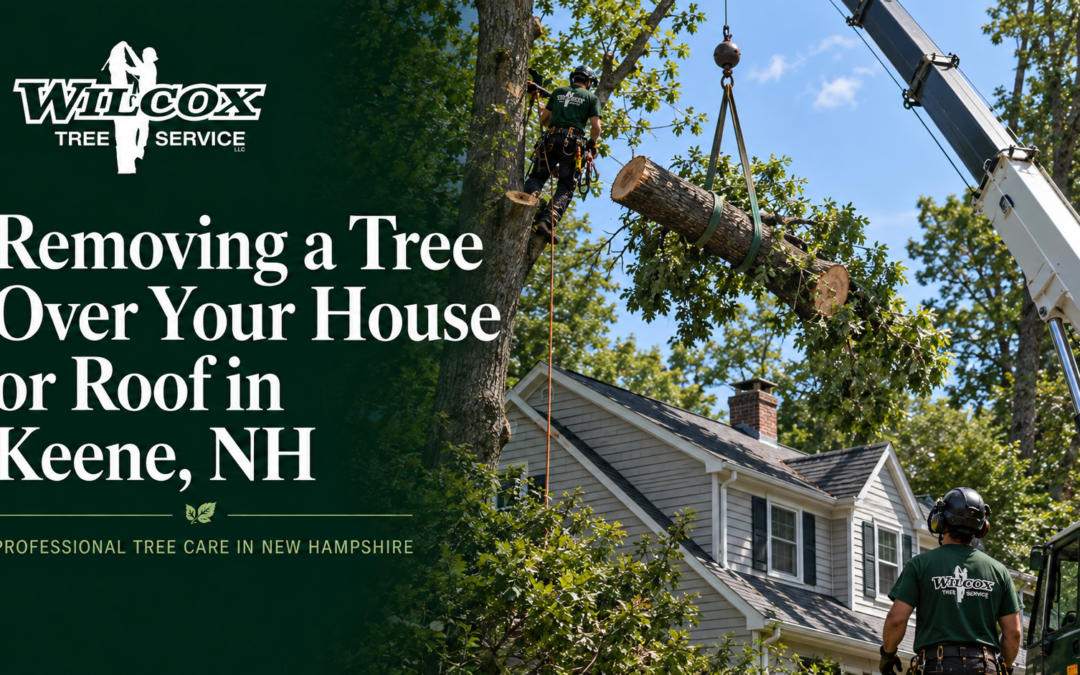
The short answer we gave the Ramirez family is the same one this post walks through. With a crane, the heavy sections come off the tree by traveling up and away from the house, not down toward it. Nothing has to fall for the tree to come down.
Why a Tree Over the House Is the Hardest Removal There Is
A tree standing directly over your house is the hardest kind of removal because there is no room for a mistake. On most jobs, if a section swings a little or lands a foot off the mark, it hits grass and no one notices. Over a roof, that same foot is the difference between a clean job and a hole in your shingles.
Everything about the work gets stricter once the drop zone is the house itself. Whoever is planning the removal has to account for the weight of every piece before it is cut, the exact path it will travel, and what sits underneath it the entire way. Roofs, skylights, gutters, chimneys, and the siding along the eaves are all in play at the same time, and none of them forgive a bad guess.
The weight of green wood is what surprises most homeowners. A section of trunk that looks manageable from the ground can weigh far more than people expect, because living wood is full of water and water is heavy. A piece no longer than a couch can outweigh a small car. Let a load like that build any momentum over a roof and there is no rope or hand strong enough to stop it gently.
Trees over a house also tend to lean the wrong way. Years of reaching for light pull the canopy out over the roof, so the weight is already tipped toward the very thing you want to protect. That is why this is a job you plan around control from the first cut, not one you muscle through and hope for the best.
The Risk of Doing This the Old Way in Keene
The traditional way to take down a tree near a house is rigging. Ropes get set in the canopy, the cutter takes a limb, and the ground crew lowers it under control to a clear spot. For plenty of trees around Keene, done by a skilled crew, rigging is a perfectly good method and it is what the job calls for.
The trouble over a house is that every limb still has to pass over the roof on its way to the ground. Each lower is its own small gamble. A branch turns out heavier than it looked. A rope slips a few inches under load. A limb swings on the way down and clips the fascia or drags across the shingles. Any one of those is minor on its own. Stack thirty or forty of them over your roof in a single day and the odds of something touching down where you did not want it start to climb.
Skylights are the part that worries us most with the old approach. Glass over a bedroom or a kitchen has almost no tolerance for a glancing blow, and it sits flush with the roof right in the path a lowered limb wants to swing through. Gutters bend from a light knock. Ridge caps crack. None of it is dramatic in the moment, but it is the kind of damage that shows up as a leak months later.
And free dropping, just cutting limbs and letting them fall, is simply off the table when a roof is underneath. So is standing on a ladder and reaching out over the house with a saw. Those shortcuts are how roofs get damaged and how people get hurt. When the target is directly over the living space, the safe methods are the slow, controlled ones, and the safest of all is to keep the weight off the roof entirely.
How a Crane Removes a Tree Over a Structure
A crane turns the whole problem around. Instead of lowering pieces down through the danger zone, the crane holds each section from above, takes its full weight before the cut is finished, and then carries that section up and away to open ground. The core idea is short and it is the reason the method works over a house: nothing falls. In the trade this is called picking, and every piece of the tree gets picked off rather than dropped.
Rigging and Securing Each Section First
Before any cut is completed, the section is already tied to the crane. Our climber works from the tree if it is sound, or from an adjacent tree or a bucket truck if it is not, and sets the attachment point on the piece that is coming off next. The crane’s line is clipped on and the operator takes up tension until the machine, not the tree, is carrying that weight.
Only then does the saw finish the cut. The moment the wood separates, the section is already hanging from the crane. It does not drop, because there is nowhere for it to drop to. It is held. The operator and the climber stay in constant contact by radio, and the operator lifts just enough load before the cut so the climber never feels a sudden release. That is what people mean when they say nothing falls freely on a crane job over a house. Each piece is secured before it is ever free.
Lifting Clear of the Roofline
Once a section is cut loose and hanging, the operator lifts it straight up first, clear of the roofline, and only then swings it out and away from the house toward a staging spot in the driveway or an open part of the yard. The load goes up and away, not down. It never travels through the space directly above the roof on its way to the ground, which is exactly the space you are trying to keep clear.
The ground crew guides each section in at the staging area, releases it, and processes it while the crane heads back to the tree for the next pick. The work moves from the top down. Small branches come off first so they do not snag the cable, then the larger canopy sections, then the trunk in pieces of roughly six to twelve feet, until all that is left is a short stub standing in the clear well below the roofline. That last piece is short enough to fell the ordinary way, straight into open ground where it can do no harm.
What Homeowners Should Ask Before This Kind of Job in Keene
If you are getting quotes for a tree over your house, a few questions will tell you quickly whether a company has really thought the job through. These are the same things we walk homeowners through when we come out, so none of them should catch a good crew off guard.
Start with placement. Ask where the crane will sit and whether it can reach the whole tree from there. A crane needs firm, level ground for its outriggers and a clear line to the tree, usually in the driveway. Reach matters just as much as the ground, because a crane lifts less weight the farther out it has to stretch. A company that has looked at your property will already have an answer.
Ask whether they own the crane or hire one in. Owning the machine means one crew, one plan, and scheduling that stays under a single roof instead of waiting on a subcontractor’s calendar. Ask about insurance too, and specifically about coverage for crane work over a structure. A removal over your roof is the exact situation where that coverage earns its keep, so it is worth confirming before anyone climbs.
Then ask them to walk you through the plan for the day. Where does the truck set up, where do the sections stage, how is the lawn protected from the outriggers and the loads, and what happens to the wood and the debris when it is over. Finally, ask what they do if the weather turns. The honest answer is that the job waits, because wind and rain stop crane work, and a crew that tells you they would push through marginal conditions is telling you something you do not want to hear.
How Wilcox Crane Service Removes Trees Over Keene Homes
When a tree over a house comes to us, the first step is always an assessment. We come out and look at the tree, the house, the access, and the ground, and we work out where the crane can set up and how far it has to reach. Part of that visit is an honest read on whether a crane is even the right call. Not every tree needs one, and we will say so if yours does not. When it is the right tool, we explain why.
From there we build the rigging plan: the order the picks come off, where each section stages, where every crew member stands, and how we protect your lawn from the outriggers and the loads. On the day of the job the crane sets up on its outriggers, mats go down over the grass, and our climber sets the first pick while the operator takes the weight. Sections travel up and out to the staging area, the crew works under a strict rule that no one stands beneath a load, and the radio keeps the climber and the operator on the same page from the first cut to the last.
We run this as crane service for tree removal in Keene, NH, a dedicated part of Wilcox Tree Service rather than a machine we borrow when we need it. Most residential companies in the Monadnock Region subcontract their crane work, which adds a middleman and ties your schedule to someone else’s. We own ours, so the same team that plans your removal is the team that runs it.
If the tree over your house is already dead or storm-damaged, taking it down becomes a hazardous tree removal job, and the crane matters even more, because a weakened tree cannot always be climbed or rigged safely. Lifting it apart from above keeps our crew off a tree that can no longer be trusted to hold weight. When the last section is down, we finish the way we would on any job: brush chipped, logs cut to length, debris raked up, decks and walkways blown clean, and a final walk around the property with you before we pull out.
Tree hanging over your Keene roof? Call Wilcox Tree Service at 603-903-8624 for a safe, controlled removal.
Frequently Asked Questions
- How do you remove a tree hanging over my house in Keene?
We use a crane. Our climber attaches each section of the tree to the crane’s line before the cut is finished, so the operator is already carrying the weight when the wood separates. The piece then lifts up and away from the roof to a staging spot in the driveway or yard, rather than dropping down toward the house. We work from the top down, taking the small branches first, then the canopy, then the trunk in sections, until only a short stub is left standing in the clear where it can be felled on the ground. Nothing has to fall over the roof for the tree to come down.
- Can a tree over my roof be removed without damaging it?
Yes, and that is the whole reason to bring in a crane for this kind of job. Because every section is held from above and carried clear of the roofline, no branch ever travels down through the space over your shingles. We plan each lift so the load does not pass over the parts of the house we are protecting, and we set the crane where it has a clean reach to the tree. Skylights, gutters, and the chimney stay out of the load path from the first pick to the last, which is exactly how the roof comes through untouched.
- Why is a crane safer for a tree over a structure?
Traditional rigging lowers each limb down on ropes, which means every piece passes over the roof on its way to the ground, and that risk adds up across dozens of lowers in a single day. A crane removes that risk by taking the weight before the cut and lifting the section up and out instead of down. Nothing falls freely, so a rope slipping or a branch being heavier than it looked no longer puts your roof in the path. For a tree standing directly over a house, that difference is what keeps the shingles, and everyone on the ground, out of harm’s way.
- Where does the crane sit when a tree is over the house?
Usually in the driveway or another firm, open spot with a clear line to the tree. The crane needs level, stable ground for its outriggers and enough reach to lift each section over the house and swing it to a staging area. Finding that spot at your specific property is part of our assessment, along with confirming the crane can reach the whole tree from there, since a crane lifts less the farther it has to stretch. In tight settings we take the time to position the truck correctly before any cutting begins.
- Does Wilcox Crane Service handle trees directly over Keene homes?
Yes. Trees growing over a house are one of the main reasons we run a dedicated crane operation. Wilcox Tree Service owns the crane rather than hiring one out, so the same crew that plans your job is the crew that runs it, and the scheduling stays under one roof. We handle removals over roofs, pools, decks, and tight side yards throughout Keene and the wider Monadnock Region. If you are not sure a crane is needed for your tree, we will look at it and tell you honestly.
- What should I ask before a removal over my roof?
Ask where the crane will sit and whether it can reach the whole tree from that spot. Ask whether the company owns the crane or subcontracts it, since owning it keeps the plan and the crew together. Ask about insurance for crane work over a structure, and ask them to walk you through the plan for the day, from setup to cleanup and what happens to the wood. Finally, ask what they do if the weather turns, because wind and rain stop crane work, and the honest answer is that a safe job waits for a safe day.