
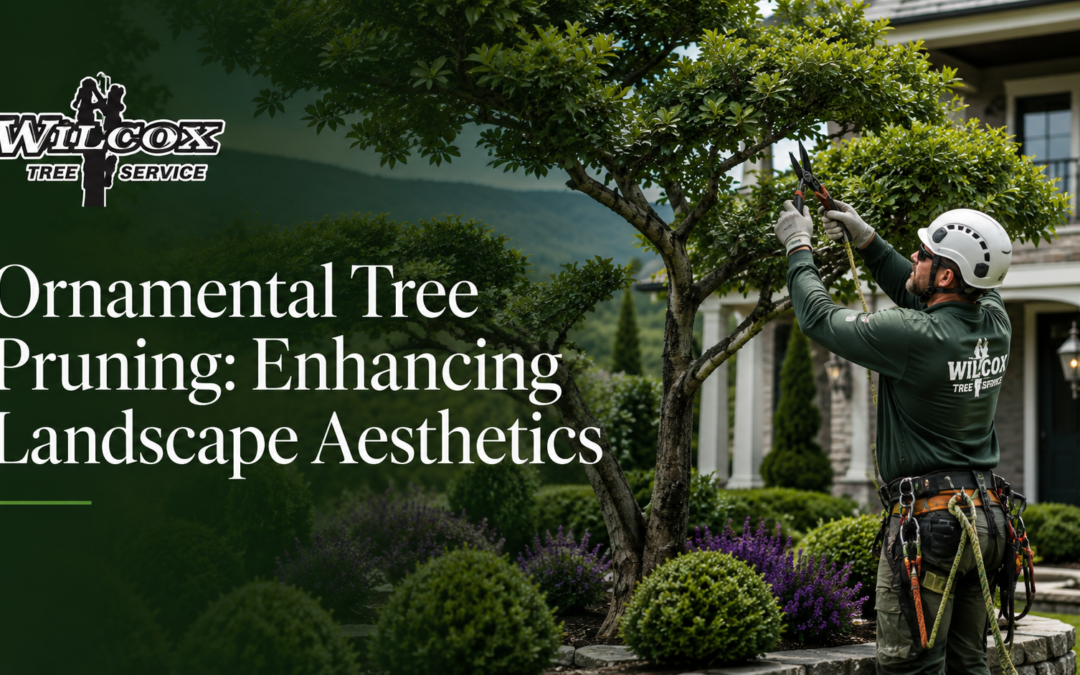
Ornamental trees are the jewelry of your landscape — dogwoods, cherry trees, Japanese maples, magnolias, crabapples, redbuds. They’re planted for their beauty, and pruning them well means enhancing that beauty without compromising the tree’s health. This requires a different approach than pruning large shade trees. Here’s how Wilcox Tree Service handles ornamental tree work.
What Makes Ornamental Pruning Different
Standard shade tree pruning focuses on structure, clearance, and hazard reduction. Ornamental pruning adds:
– Flower display enhancement
– Form refinement
– Feature branch highlighting
– Seasonal interest preservation
– Proportional balance
Getting it wrong means losing a season of blooms, damaging the tree’s natural form, or both.
Flowering Trees: Timing Is Everything
The single most important rule: prune after flowering, not before.
Spring-flowering ornamentals (crabapples, cherries, dogwoods, magnolias, lilacs): – Flower buds form on previous year’s growth – Pruning in winter removes flower buds – Best time: Within 2–4 weeks after flowers fade
Summer-flowering ornamentals (crape myrtles, some hydrangeas): – Flower on new current-season growth – Best time: Late winter or early spring, before growth starts
Getting this wrong is the most common ornamental pruning mistake. Someone “cleans up” a dogwood in January and wonders why it doesn’t bloom that spring.
Common Ornamental Species and Their Needs
Japanese Maples. Minimal pruning. Remove deadwood, crossing branches, and occasional thinning. Preserve the natural layered form.
Flowering Cherries. Prune right after flowering. Remove suckers from the base annually. Manage size by selective tip pruning.
Dogwoods. Very light pruning. Remove deadwood and crossing branches. Over-pruning triggers disease susceptibility.
Crabapples. More tolerant of pruning. Annual work maintains form, removes water sprouts, and improves fruit/flower display.
Magnolias. Minimal intervention. Remove dead/damaged branches only. Wounds heal slowly.
Redbuds. Light annual pruning. Remove competing leaders on young trees for better mature form.
Lilacs. Post-bloom pruning. Remove oldest stems (1/3) every 2–3 years to encourage new growth.
Selective Thinning for Display
For flowering ornamentals, selective thinning often improves flower display: – More light penetration = more flower bud formation – Fewer crowded branches = larger individual flowers – Better air circulation = less disease pressure
But this is subtle work — removing specific competing branches, not general canopy reduction.
Structural Pruning for Young Ornamentals
Young ornamental trees benefit from formative pruning: – Establish central leader (or preserve multi-stem form for species that prefer it) – Space scaffold branches evenly – Remove crossing and rubbing branches early – Develop clean trunk character
Done right in the first 5 years, a young ornamental develops into a stunning mature specimen. Done wrong (or not at all), even a high-quality nursery tree becomes structurally flawed.
What to Avoid on Ornamentals
- Topping — ruins natural form, destroys years of flower bud development
- Over-thinning — exposes bark to sun damage, weakens interior branches
- Excessive sucker removal during flowering — can damage active flowers
- Pruning during stress — drought, disease, or just after transplant
- Heavy pruning of slow-healing species — magnolia, dogwood, Japanese maple
Maintenance Frequency
- Annual light pruning for most ornamentals
- Selective thinning every 2–3 years
- Major rejuvenation pruning for older overgrown specimens when appropriate
Let the Right Hands Touch Your Ornamentals
Ornamental pruning is where the difference between a competent crew and skilled professionals really shows. Call 603-363-8197 or request a free estimate and we’ll treat your specimen trees with the care they deserve.