
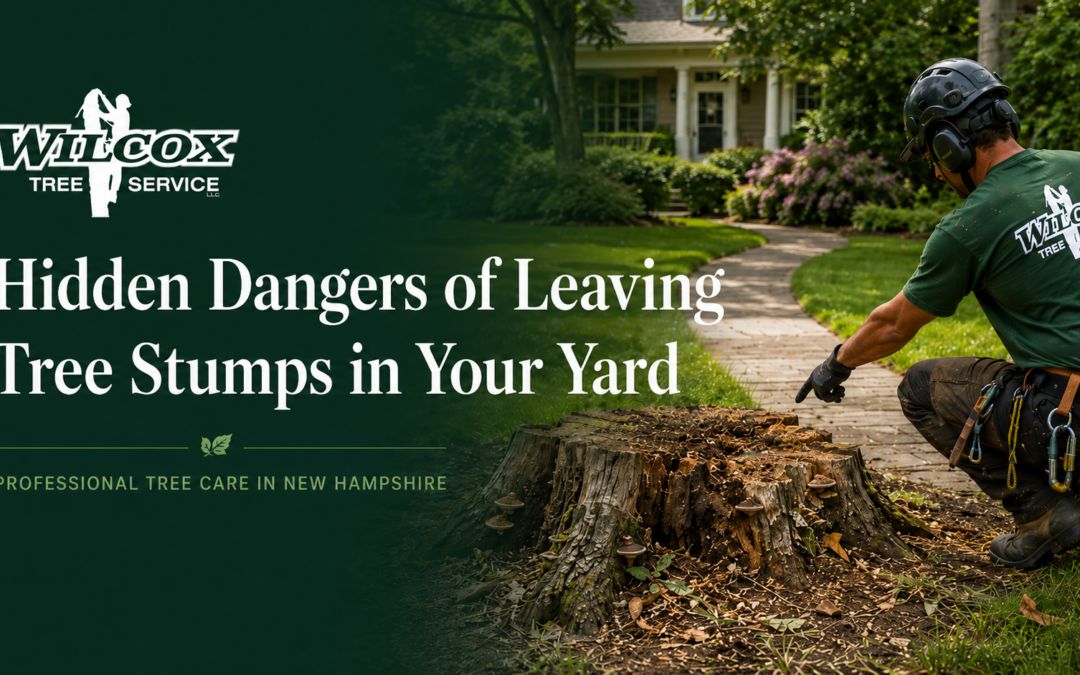
Most homeowners view old stumps as an aesthetic issue at worst. In reality, stumps create a series of hidden risks that get worse over time — to your property, your family’s safety, and your landscape’s health. Here are the dangers that most homeowners don’t realize they’re living with, from the team at Wilcox Tree Service.
1. Pest Colonies Move In
Decaying wood is a five-star hotel for insects:
Carpenter Ants. Unlike termites, carpenter ants don’t eat wood — they excavate it for nesting. A dead stump is ideal habitat. Once established, they expand colonies to structures nearby, including your home. That stump 30 feet from your house can easily become the launching point for ants in your siding.
Termites. Less common in New Hampshire than further south but present. Termites actually eat the wood in stumps and, once established, readily move to structural wood in buildings.
Bark Beetles and Borers. Many species infest dying and dead wood. Some (like emerald ash borer from adjacent dead stumps) threaten surviving healthy trees.
Wasps and Hornets. Hollow stumps are prime nesting sites. Bald-faced hornets, yellow jackets, and paper wasps love them.
2. Fungal Disease Reservoirs
Old stumps harbor fungal pathogens that threaten other trees:
Armillaria Root Rot (Honey Fungus). One of the most destructive forest pathogens. Colonizes dead stumps, then spreads through soil and root grafts to healthy trees nearby. A single old stump can infect a whole yard.
Various Heart Rot Fungi. Some fungi persist in dead wood for years and spore out onto living trees.
Grinding reduces this disease pressure dramatically.
3. Silent Structural Damage from Root Decay
As stumps decay, their root systems fail too. This can cause:
Driveway Settling. Old tree roots under a driveway eventually decompose, leaving voids that cause asphalt or paver settling.
Foundation Issues. Rarely but occasionally, major root decay near a foundation creates soil movement.
Septic and Utility Line Issues. Decaying roots can create pathways that allow soil movement around utilities, sometimes causing damage.
4. Trip and Fall Injuries
This is the most immediate risk. Stumps — especially low ones nearly invisible in grass — cause:
- Ankle sprains and fractures
- Knee injuries
- Face-first falls on concrete or rock
- Head injuries
A slip-and-fall on your property can trigger an insurance claim or lawsuit. And even without legal issues, your kid breaking an ankle on a hidden stump is nobody’s idea of a good weekend.
5. Lawn Equipment Damage
Hitting a stump with: – A mower blade: Can cost $100–$500 in repairs, up to replacing the deck or engine – An aerator: Damages or breaks tines, may damage the machine – A tiller: Can bend or break expensive equipment – A snowblower: Hidden under snow, stumps can destroy augers
6. Property Value Reduction
Home buyers notice stumps during showings. They signal: – Deferred maintenance – Unknown tree history (was it diseased? Damaged?) – Future expense to remove – Sloppy landscaping
Even one prominent stump can reduce perceived property value by more than the cost to grind it.
7. Sprouting and Weed Pressure
Many species resprout from roots after cutting: – Willow – Poplar and cottonwood – Black locust – Tree of heaven (invasive) – Some maples – Sumac
These sprouts can turn into thickets if ignored. Grinding prevents most resprouting.
8. Mold and Moisture Issues
Decaying wood holds moisture. In the wrong location, this: – Creates persistent wet spots in the lawn – Supports mosquito breeding in depressions – Contributes to mold near structures – Generates unpleasant smells during decomposition
9. Fire Hazard Potential
Dry, decayed stumps can smolder for hours or days if a grass fire or brush burn gets into them. In rural NH, this is a real concern. Ground stumps don’t have this issue.
10. Wildlife Attractants You Don’t Want
Stumps attract: – Rodents (mice, voles) nesting in the root system – Skunks and raccoons foraging for larvae – Woodpeckers (hammering noise close to house)
All fine in a woodlot — not ideal 20 feet from your back door.
The Cost of Inaction
What people don’t realize: the “free” option of leaving a stump isn’t free. Over 5 years, a neglected stump costs: – Risk of lawn equipment damage – Ongoing sprouting/weed control labor – Potential pest issues that may spread to your house – Insurance liability exposure – Property value reduction
Contrast this with $150–$300 for grinding now.
Take Action
If you have one or more stumps on your property, let’s get them handled before they become a bigger problem. Call 603-363-8197 or request a free estimate.