
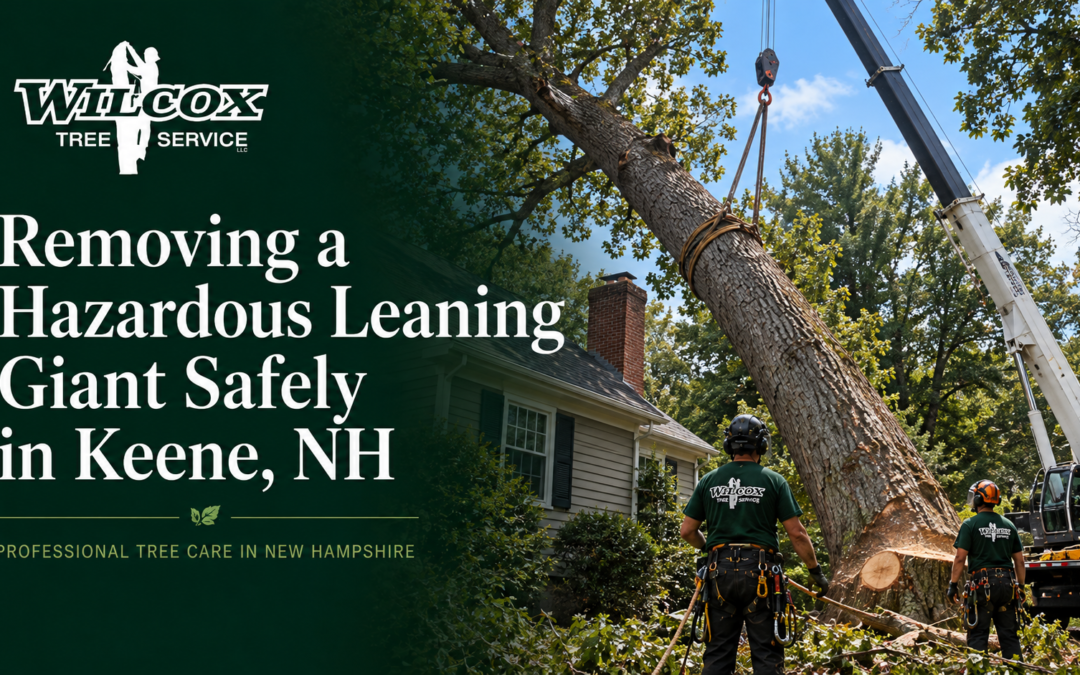
Ray and Diane Cole had watched the same maple for years. It stood at the back edge of their lot in Keene, NH, a giant that shaded half the yard on a July afternoon and turned gold every October. For a long time it was just part of the place.
Then it started to lean. Not all at once. A little more each season, the way these things go, until the whole crown hung out over the fence and pointed straight at the neighbor’s garage. Diane noticed the ground on the high side had begun to lift.
By late summer the tree had gone from a favorite to a worry. It was far too big for anyone to climb safely, and it was leaning too hard to simply cut down and drop. There was a building in the way, and a driveway, and no clean place for a tree that size to land.
That is the exact situation we see more often than people expect around Keene. A large tree does not usually become dangerous overnight. It leans, it loads up on one side, and one day it is holding a lot of weight over something you really do not want it to hit.
The answer for the Coles was not muscle. It was control. We brought in a crane to hold the weight from above and take the maple apart one measured piece at a time, so nothing moved until we wanted it to.
Why a Large Leaning Tree Is So Dangerous to Remove
A big leaning tree is dangerous because it is already under load. Gravity has been pulling it in one direction for years, and the wood, the roots, and the soil are all carrying that strain right now, before anyone lays a hand on it.
Think about what a lean really means. The trunk is not sitting straight over its own base anymore. All that weight up in the crown is hanging out to one side, and the tree is holding itself there with stored tension, like a spring that has been wound and left. Cut the wrong fiber, and that tension lets go on its own schedule instead of yours.
That is the part that catches people off guard. A healthy, upright tree tends to fail in fairly predictable ways. A heavy leaner does not. The roots on the low side may already be loose or partly torn, the soil may be lifting, and there can be cracks running through the trunk that you cannot see from the ground. Any one of those can give way with very little warning.
Then there is the target. A leaning giant is almost never hanging over open lawn. It is over a garage, a roof, a fence line, a driveway, or the power drop to the house. The whole reason it feels urgent is that the weight is aimed at something. When a tree that size comes down the wrong way, it does not cause a small problem. It causes the kind of damage that takes months to put right.
So the danger is not just that the tree is big. It is that it is big, loaded, unpredictable, and pointed at something you care about, all at the same time.
Why You Cannot Just Climb or Fell a Leaning Giant
When folks picture tree removal, they usually picture one of two things. Someone climbs up with a saw and takes it down in pieces, or someone makes a couple of cuts at the base and the whole tree drops into the yard. On a big leaner, both of those can go wrong fast.
Start with climbing. Putting a person up into a tree only works if the tree can be trusted to hold them. A heavy leaner cannot give you that promise. The very thing that makes it hazardous, the stored load and the hidden cracks, is also what makes it a bad place to send someone with a rope and a saw. Every cut a climber makes changes how the weight is balanced, and on a compromised trunk that shift can travel in a direction nobody planned. You do not want a member of the crew tied into a tree at the moment it decides to move.
Now think about felling it, meaning cutting it at the base and letting it drop. On open land with room to spare, that can be the right call. Over a garage in a Keene backyard, it is not. A lean gives the tree a strong head start in one direction, and once a trunk that heavy starts to go, there is no steering it and no stopping it. Even a skilled cut cannot promise the tree will miss the building it is already pointing at. And if the trunk is hollow or cracked, it can break apart partway down and throw pieces more than one way.
There is also the matter of what happens after that first big move. A dropped leaner can kick back, roll, or slam limbs into fences and vehicles well outside the spot you were watching. Tight lots do not give you that margin for error.
This is why, for a large leaning hazard, the honest answer is often that neither climbing nor free felling is safe enough. You need a method that keeps people out of the tree and never lets the tree fall on its own terms. That is where holding the weight from above changes everything.
How Crane Support Makes a Hazard Removal Controlled
The idea behind crane-supported removal is simple to say and makes all the difference in the yard. Before a cut is made, the crane takes hold of the section that is about to be cut. The weight is already supported from above, so when the cut is finished, that piece does not fall. It lifts.
Here is how it plays out on a leaner like the Coles’ maple. Our team picks a section of the tree, the crane’s line is set on it and drawn snug, and only then does the saw go to work. As the last of the wood is cut, the crane is already carrying the load, so the piece hangs there under control instead of dropping. The crane then swings it clear of the house and the fence and sets it down in a spot where the ground crew can cut it up on open ground.
Then we do it again. And again. A big tree comes down as a series of controlled lifts, each one planned, each one held, from the top of the crown down toward the trunk. Nothing is left to chance or to gravity. Because every piece is supported before it is freed, the tree never gets the chance to fail unexpectedly. The stored tension that made it so dangerous is taken out of the picture one section at a time.
That control is the whole point. On the hardest removals, our crane service for tree removal in Keene is what lets us take apart a tree that could not be climbed and would never be safe to drop. It turns a frightening, unpredictable job into a slow, deliberate one.
Keeping Crews Out of the Failing Tree
The single biggest safety gain of crane work is where our people stand. On a crane-supported removal, no one has to climb the failing tree.
On a leaner, that matters more than anything else we do. The trunk that is holding all that stored load is the last place anyone should be. With the crane carrying each piece, the saw work is done from planned, protected positions, and the ground crew stays clear of the fall zone the whole time. If the wood does something we did not expect, there is no one tied into it when it happens.
We would rather solve a hard tree with reach and planning than by asking a person to trust a trunk that has already shown it cannot be trusted. A machine can hold weight over a roof all afternoon without tiring. That is exactly the kind of steady, boring reliability you want on a dangerous job.
Protecting What the Tree Leans Over
The other reason we reach for a crane on these jobs is what sits underneath the tree. A leaning giant is dangerous precisely because it hangs over something, a neighbor’s garage, your own roof, a shed, a fence, or the wires running to the house.
Because each section is lifted rather than dropped, we control where every piece goes. The crane can pick a heavy limb straight up off the top of the tree, swing it out over the open part of the yard, and lower it to the ground without it ever passing over the building below. For the Coles, that meant the maple could come off the property without a single branch touching the neighbor’s garage roof it had been threatening for two summers.
It also keeps the yard itself in better shape. There is far less dragging of huge logs across the lawn and far less risk to the driveway, the flower beds, and the septic area, because the heavy pieces are set down where we want them instead of crashing down wherever they land.
When a Leaning Tree Cannot Wait in Keene
Not every tree with a bit of a lean is an emergency. Plenty of trees have grown at a slight angle their whole lives and are perfectly sound. The question homeowners really want answered is a different one. When does a leaner stop being something to keep an eye on and become something to deal with now?
These are the signs we take seriously around Keene.
A lean that is new or getting worse. A tree that has always tilted the same way is one thing. A tree that has started to lean, or is leaning a little more each season, is telling you something is shifting underneath it. A sudden lean after a storm is an especially loud warning.
Soil lifting or cracking at the base. If the ground on the high side of the lean is heaving, mounding, or cracking, the root plate is beginning to pull out of the earth. That is one of the clearest signs a tree is on its way over.
Exposed or torn roots. Roots that are lifting out of the soil, or that look torn on the low side, mean the anchor holding the tree up is failing.
Cracks in the trunk or a hollow sound. Visible splits, seams, or a hollow tone when the trunk is tapped all point to wood that may not hold its load much longer.
Dead limbs or a dead top over a target. A leaner that is also dropping deadwood over a roof or driveway is carrying two hazards at once.
The tree is aimed at something important. A sound tree over an open field can often wait and be watched. A tree over the house, the garage, the driveway, or the power line does not get the same patience.
Weather is a big part of the picture here too. Our winters load trees with heavy wet snow and ice, and our storms bring the kind of wind that finds every weak point. A leaner that looks stable in calm July weather can be a very different animal under a February ice load. If a tree is already leaning hard over something that matters, the safe move is to have it looked at before the next big storm, not after.
How Wilcox Tree Service Removes Hazardous Giants in Keene
When you call us about a big leaning tree, the first thing we do is come look at it. There is no substitute for standing under a tree and reading it in person.
Our team starts with a real assessment. We look at the direction and degree of the lean, the condition of the trunk, the state of the roots and the soil around the base, and, just as important, what the tree is leaning over. We sort out how urgent it is, whether it is something to remove soon or a true emergency, and we plan the safest way to bring it down. On a leaner over a structure, that plan almost always runs through the crane.
From there, the removal itself is the controlled, piece-by-piece process we walked through above. We set up in a safe spot, protect the areas that matter, and use crane support to lift each section clear rather than drop it. Because we run our own hazardous tree removal in Keene, the same team that plans the job is the team that carries it out, with the 45-ton crane and 127-foot boom that let us reach trees conventional methods cannot safely touch.
When the tree is down, we do not leave you with a mess. We clear the wood and debris, tidy the work area, and can grind the stump if you want the spot cleaned up for good. The goal is that the hazard is gone and your yard looks looked after, not torn up.
If your leaning tree is a crane job, our crew handles that side under Wilcox Tree Service as well, so the lifting and the tree work are coordinated by one outfit instead of two. For a standard hazardous removal, reach our general line at 603-363-8197. For crane-specific questions, you can also reach the crane line at 603-903-8624. Either way, you are talking to the people who will actually be in your yard.
Frequently Asked Questions
- How is a large leaning tree removed safely in Keene?
A large leaning tree is removed safely by supporting its weight from above instead of climbing it or dropping it. We set a crane line on each section before it is cut, so the piece lifts away under control rather than falling. The tree comes down as a series of planned lifts, from the crown toward the trunk, and each heavy piece is swung clear of the house and set down in the open. It is slow, deliberate, and keeps our people out of the failing tree.
- Why is a leaning tree dangerous to cut down?
A leaning tree is dangerous to cut down because it is already under load. Its weight is hanging out to one side, held there by stored tension in the wood and roots. Cut in the wrong place and that tension can release on its own, sending the tree over before anyone is ready. On top of that, the roots may be torn and the trunk may be cracked in ways you cannot see, so a heavy leaner often fails in directions a healthy tree never would.
- Does a crane make removing a hazard tree safer?
Yes. A crane is often the safest way to take down a large hazard tree. Because the crane holds each section before it is cut, the wood never gets a chance to fall on its own. Our crew stays out of the failing tree, and every piece is lifted clear of whatever the tree was leaning over, then set down in a safe spot. For big leaners over homes, garages, or wires in Keene, that kind of control is hard to match with any other method.
- Can a leaning tree over my neighbor’s property be removed cleanly?
In most cases, yes. Lifting each piece with a crane lets us control exactly where it goes, so heavy limbs can be picked straight up and swung over the open part of the yard instead of over the structure below. That is often the only clean way to take a tree off a shared line without touching a neighbor’s garage or fence. We plan the lifts around what sits underneath and keep the pieces away from anything we are trying to protect.
- How do I know if my leaning tree needs to come down now?
Watch for a lean that is new or getting worse, soil that is lifting or cracking on the high side, roots that look torn or exposed, and cracks or a hollow sound in the trunk. A dead top or dead limbs hanging over a roof or driveway add to the risk. If a leaning tree shows any of these signs, especially over something you value, have it looked at soon, and ideally before the next big snow or wind storm rather than after.
- Does Wilcox Tree Service handle big hazardous leaning trees in Keene?
Yes. Handling big, hazardous, leaning trees is a core part of what we do across Keene and the rest of Cheshire County. Wilcox Tree Service brings the assessment, the crane support, and the cleanup together so the whole job is handled by one team. If your tree is too large to climb and too unstable to drop, that is exactly the situation our crane-supported removals are built for. Call our general line at 603-363-8197 and we will come take a look.