
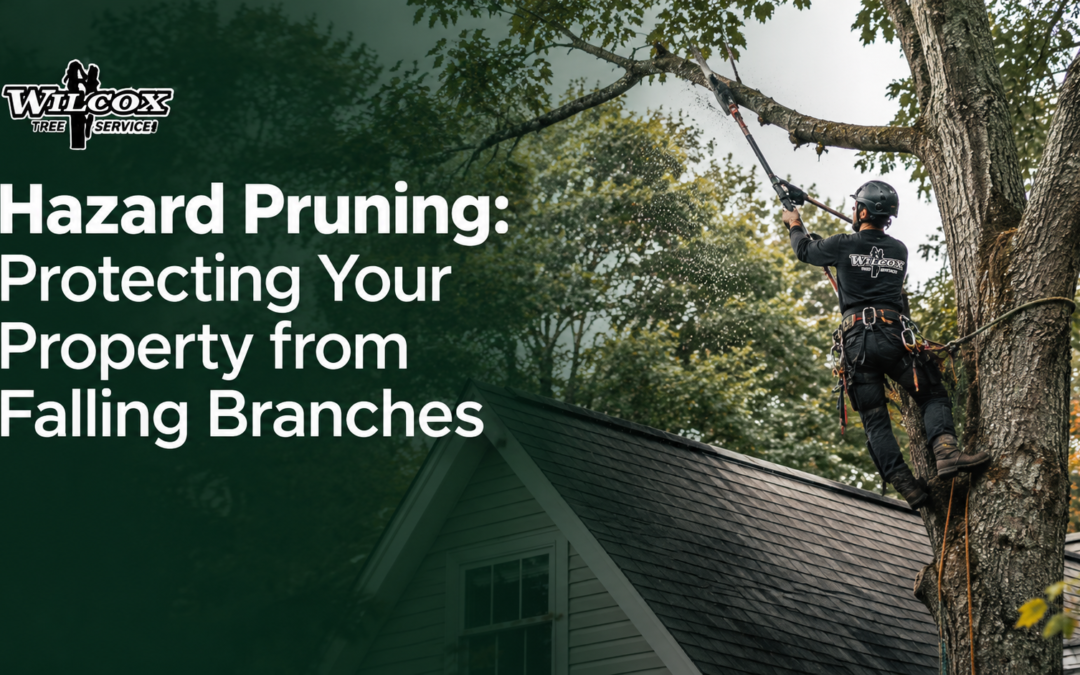
Hazard pruning is a targeted form of tree maintenance — not about beautifying a tree or opening the canopy, but about surgically removing specific branches that pose identifiable risks. When done proactively, hazard pruning prevents property damage and injury. When delayed, it often turns into an emergency removal. Here’s how Wilcox Tree Service approaches hazard pruning and when homeowners should consider it.
What Makes a Branch Hazardous?
Not every large or unattractive branch is hazardous. A branch becomes a hazard when it combines:
- A defect (dead wood, crack, weak attachment, decay)
- A target (structure, driveway, walkway, play area, vehicle)
- Failure probability (condition worsening over time)
Remove any one of those three and the hazard is mitigated.
Types of Hazard Pruning
- Deadwood Removal. Dead branches over target zones. See our dedicated post on deadwooding.
- Weak Union Reduction. Branches with included bark at their attachment point are prone to splitting. Reducing weight on these branches buys time before they need removal.
- Cracked Branch Removal. Visible cracks in major limbs require immediate attention.
- Long Lateral Reduction. A horizontal branch extending 20+ feet from the trunk generates enormous leverage. Shortening it reduces failure risk.
- Co-dominant Stem Correction. When a tree splits into two equal leaders, one often needs reducing to prevent full-trunk splitting.
- Storm-Damaged Limb Removal. Partial breaks, hanging branches, and wind-loosened sections.
When to Schedule Hazard Pruning
- After any significant wind event
- After ice storms that loaded branches heavily
- When visible defects appear (cracks, hanging branches, exposed cambium)
- As part of pre-storm-season prep
- When dead branches develop over target zones
Proactive scheduling is safer and easier to manage than emergency response.
Hazard Pruning vs. Hazardous Tree Removal
These are different services: – Hazard pruning removes specific branches from an otherwise sound tree – Hazardous tree removal removes the entire tree when the structure is compromised
Sometimes hazard pruning buys a few more years for a tree before full removal becomes necessary. Our team will tell you honestly when pruning is a solution and when removal is inevitable.
Technique Considerations
Hazard pruning cuts are often larger than routine pruning cuts (because the hazardous branches tend to be substantial). This means: – Higher risk to the climber – More rigging to control the descent – Potentially a crane for very large hazardous branches – More careful technique to avoid additional damage
Why Not Just Remove the Whole Tree?
Valid question. For many mature valuable trees, hazard pruning: – Preserves a significant landscape asset – Avoids unnecessary full-tree removal when the remaining structure is sound – Maintains ecosystem value (shade, habitat) – Buys years or decades of additional life
For trees where structural compromise is widespread, removal is the right answer. We’ll tell you honestly which camp your tree falls into.
Insurance Implications
Documented hazard pruning demonstrates due diligence to insurance companies. If you have a tree that has concerning features, a record of regular hazard pruning protects you if something does eventually fail. Our tree trimming team generates documentation for your records.
Schedule a Hazard Assessment
Concerning branches on your property? Call 603-363-8197 or request a free on-site assessment.