
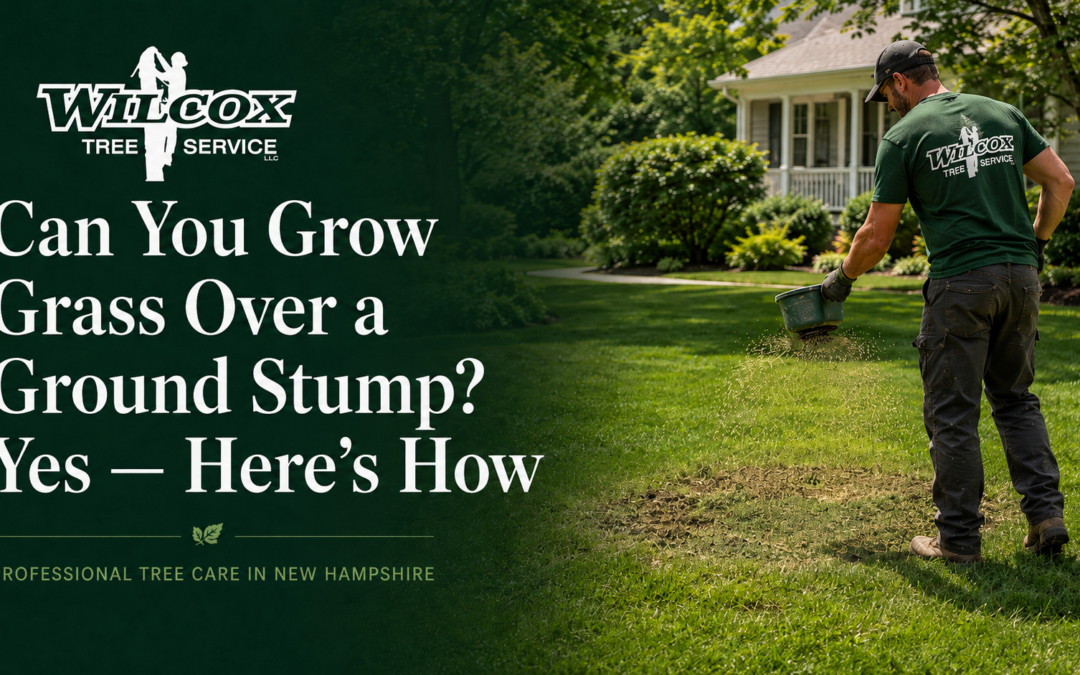
The short answer: yes, you can absolutely grow grass over a ground stump — and in most cases, a year after grinding you won’t be able to tell there was ever a stump there. The medium answer: the preparation matters. Skip the right steps and you’ll have patchy grass for years. Here’s the complete guide from Wilcox Tree Service.
Why Grass Doesn’t Always Grow Well Without Prep
Fresh stump grindings are mostly wood chips. Wood chips are: – High in carbon, low in nitrogen — temporarily ties up nitrogen during decomposition – Fast-draining — grass seed washes away easily – Prone to settling — seed level changes over months – Inhospitable to grass seed germination — not the right medium
Without preparation, seed sown directly onto grindings often fails or produces thin, weak grass.
The 4-Step Process for Success
Step 1: Remove Excess Grindings Wait at least 2–4 weeks after grinding for initial settling, then: – Rake or shovel off the top 4–6 inches of grindings – Keep a generous amount; you’ll reincorporate some later – Use removed grindings as mulch elsewhere
Step 2: Add Quality Topsoil – Spread 3–6 inches of fresh topsoil – Level with surrounding grade (or slightly higher to account for future settling) – Mix the top 2” of topsoil with remaining grindings beneath — don’t create a hard layer
Step 3: Address the Nitrogen Issue Wood decomposition pulls nitrogen from the soil. Counter this: – Apply a complete fertilizer (balanced N-P-K) to the new topsoil – Or use a starter fertilizer specifically formulated for new seed – Or mix aged compost into the topsoil before seeding
Step 4: Seed or Sod
Seeding approach: – Choose a seed that matches your existing lawn – Sow at slightly higher than recommended rate (some loss is normal) – Rake lightly to contact soil – Cover with thin straw or a seed blanket – Water daily for first 2 weeks – Water every 2–3 days until established (6 weeks)
Sod approach: – Prep soil as above – Lay sod immediately after delivery – Water deeply right after laying – Water daily for 2 weeks – Resume normal lawn care after roots establish
Best Timing in New Hampshire
Fall seeding (late August–September): – Ideal for cool-season grasses (most NH lawns) – Cooler temperatures, regular rainfall – Grass establishes before winter – Minimal weed competition
Spring seeding (April–May): – Second-best window – Must be established before summer heat
Summer seeding: – Possible but requires more watering – Heat stress limits establishment
Late fall (after mid-October): – Too late for seed to establish – Dormant seeding sometimes works but risky
Troubleshooting
“I seeded and nothing grew.” – Check if seed was viable (buy fresh from a reputable source) – Test soil pH — stumps sometimes leave acidic conditions – Ensure proper watering (not too much, not too little) – Make sure you’re using grass suited to your sun/shade conditions
“Grass grew initially but died off in weeks.” – Usually a nitrogen deficiency as wood chips compete for nutrients – Apply fertilizer and water well – May need to re-seed
“Some areas are thick, others are patchy.” – Uneven topsoil depth is the usual culprit – Topdress with thin compost or topsoil – Overseed patchy spots in fall
“The area sank and the grass is in a low spot.” – Continued settling is normal for 1–2 years – Topdress periodically to maintain level – Eventually stabilizes
Shortcuts That Don’t Work
- Just sprinkling seed over grindings without topsoil
- Using the grindings themselves as the planting medium
- Skipping watering during establishment
- Using cheap seed to “see if it works”
Save time and frustration — do it right the first time.
The Timeline
- Week 1–2: Germination
- Week 3–4: Grass starting to fill in
- Week 6–8: Ready for first mowing (3” blade height minimum)
- Month 3–4: Appears like surrounding lawn
- Year 1+: Indistinguishable from rest of lawn
Alternative: Skip the Lawn Entirely
If the location is shaded or you’d rather avoid the work, consider: – Shade-tolerant groundcovers (pachysandra, vinca, ivy) – Mulched planting bed with shrubs – Ornamental grass feature – Wildflower patch
When to Call for Help
Most homeowners handle post-grinding lawn restoration themselves. We can recommend landscapers if you prefer professional help with larger or complicated areas.
Ready to Grind?
Before you can grow grass, you need the stump ground. Call 603-363-8197 or request a free estimate.
Related Posts: Stump Grinding Aftercare · How Deep Should Stump Be Ground · What Happens to Roots After Grinding