
The Whitmores had a big silver maple leaning over their driveway on the west side of Keene, and just about everyone had an opinion about it.
A neighbor stopped by while they were raking one Saturday and told them climbing was the only “real” way to take a tree down. A crane, he said, was overkill for a backyard maple. Bring in a climber, a couple of ropes, and let a person do the work the old way. He said it with enough confidence that Kim Whitmore almost believed him.
Then, about a week later, a climbing crew showed up next door to remove a tree that was honestly a good bit smaller than the Whitmores’ maple. Kim watched them for most of a day. Then she watched them again the next morning. Ropes, rigging, up the trunk, back down, one section at a time.
By the time that job wrapped up a day and a half later, the Whitmores had stopped wondering whether their neighbor was right. They started asking a better question. Not who should take their tree down, but how it should come down.
That is the question worth asking. The crew matters, of course it does. But the method matters just as much, and on some trees it matters more. Here in Keene, we take trees down both ways, by climbing and by crane, and the right answer comes from the tree in your yard, not from which method sounds tougher at the coffee shop.
So let us walk through both, plainly, so you can see how we think about it before we ever show up with a saw.
Two Very Different Ways to Take Down the Same Tree
Both climbing and crane removal end in the exact same place. The tree is safely on the ground, cut up, and hauled off, and your yard is quiet again. How they get there is where the two methods split apart.
Climbing removal puts a trained climber up in the tree. They work their way up with a climbing line, take the tree apart from the top down, and lower each limb and section with ropes and rigging. Everything reaches the ground in controlled pieces, guided by hand and by a ground crew clearing as it comes.
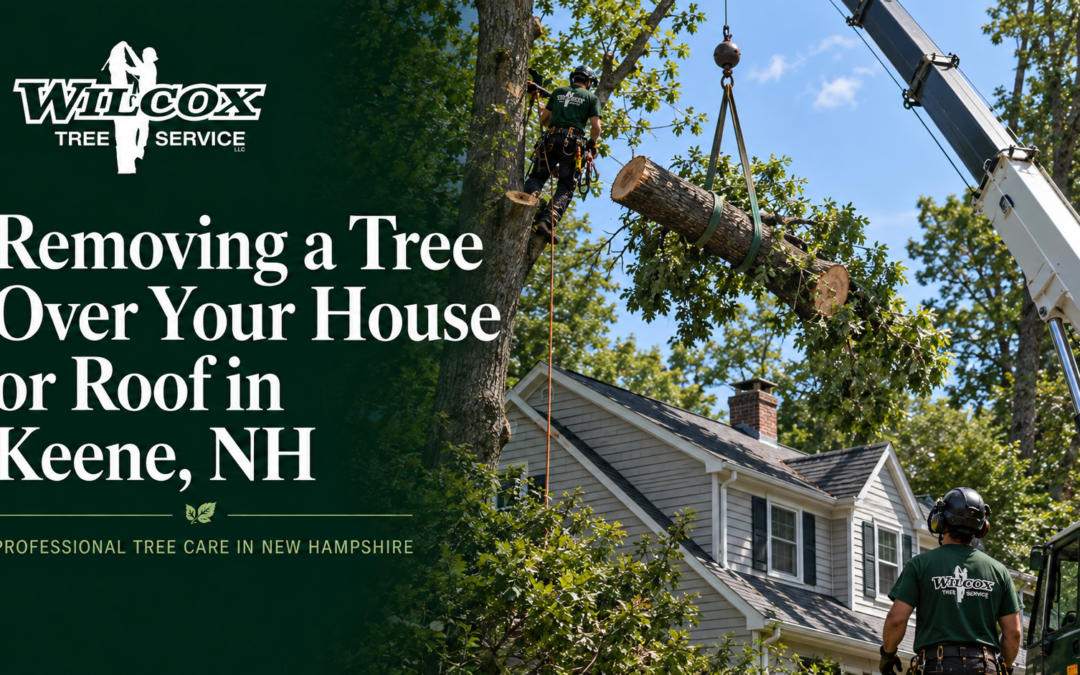
Crane removal flips that whole picture. Instead of a person carrying the tree down through its own branches, a crane lifts each cut section up and out, over the top of the yard, and sets it down in one clear spot near the trucks. The cutting still happens up in the tree, but the crane holds the weight and moves the load, not a climber’s rope.
So picture it this way. One method brings the tree down through the tree. The other lifts it up and away over the top. Same goal, very different path. And once we look at your tree and what is packed around it, the setting usually points clearly toward one of them.
How Climbing Removal Works and When It Fits
Climbing is the method most folks picture when they think of tree work, and for good reason. It has been done this way for a long time. A climber ties in, ascends with ropes and climbing spikes, and starts removing the tree from the top down. Limbs get roped off, lowered slow and controlled, then cut into pieces a ground crew can move. On a clean removal, each piece is cleared as it lands so the work keeps flowing.
It takes real skill, and it is not the kind of thing you fake. A good climber reads the tree before making a single cut. They know where the weight sits, where to notch each limb, and how to set rigging so nothing swings into the house or drops where it should not. This is craft, and when the tree is healthy and the space is open, it is a tidy, efficient way to get a removal done.
Climbing tends to be the right fit when the job looks like this:
Smaller and mid-sized trees a climber can work through safely. Healthy trees with solid wood and sound limbs to tie into. Yards where a crane simply cannot reach or cannot set up, like a tight back corner boxed in behind the house. And selective work, where you want one tree out of a cluster gone without disturbing the ones you are keeping.
For a lot of everyday removals around Keene and the Monadnock region, climbing is a fine call. When the wood is sound and there is room to work, a skilled climber and a sharp ground crew handle it without any drama at all.
Where climbing gets harder is when the tree stops cooperating. A climber depends on the tree to hold them. If the trunk is hollow at the core, the limbs have gone brittle, or the whole thing is dead and drying out, then the tree that is supposed to support the climber has quietly become the hazard. That is the moment we stop looking up the trunk and start looking up at the crane.
How Crane Removal Works and When It Wins
Crane removal changes one big thing. It changes who carries the weight. Instead of the climber and the rigging bearing each piece down through the canopy, the crane takes it. A section gets cut, the crane already has hold of it, and then it lifts that piece straight up and over the yard to a drop zone, usually the driveway or the road where the chipper and trucks are staged and waiting.
The person doing the cutting still goes up, but often not for long, and not deep into a failing tree. Section after section comes off in quick, controlled lifts, and each piece leaves the site through the air instead of being lowered through branches and dragged over the lawn.
This is where our Wilcox Crane Service earns its keep. We run crane removals across Keene and the wider Monadnock region for exactly the trees and settings that climbing struggles with. When a tree is too big, too broken, or hemmed in by a house, a shed, and a fence all at the same time, the crane is not there to show off. It is the safer, cleaner way through the job. You can read more about how we approach crane tree removal in Keene if that is the situation in your yard.
Safety on Hazardous and Compromised Trees
The biggest reason we reach for a crane is a simple one. It keeps our people out of a tree that cannot be trusted to hold them.
A dead oak, a storm-split maple, a big pine with a rotten core, a hemlock that lost half its top in an ice storm. None of those give a climber a safe anchor. Every rope and every cut in a climbing removal counts on the wood holding, and compromised wood may not hold when it matters. With a crane, the load is supported from above before a cut is ever finished. If a section lets go earlier than planned, the crane already has it. Nobody is standing on a limb, hoping it holds for three more seconds.
For hazardous trees, that difference is the whole game. We have taken down plenty of trees around Keene that we would never have asked a climber to set foot in. Ice damage after a hard New Hampshire winter, dead standing timber that has been drying for a season or two, a tree leaning hard over a roof after a wind storm rolled through. In those cases a crane is not a luxury add-on. It is the thing that lets us do the work at all without betting our crew’s safety on wood that has already failed once.
Speed and Yard Protection on Big Jobs
Speed is the other place a crane shows its worth, and on a large tree the gap is not small. Work that might take a climbing crew a long full day or more can often come down in a fraction of that time when a crane is lifting the pieces out. That is exactly what the Whitmores watched next door. A day and a half of patient climbing on a tree a crane could have cleared in a single morning.
Fewer hours is not only about being finished sooner, though most people do appreciate that. It is about what happens to your yard while the work is going on. When every piece is lifted up and set down in one staging spot, your lawn takes far less of a beating. Heavy sections are not dragged across the grass or dropped onto the ground over and over near the trunk. The crane carries them up and out over the top and lands them right where we want them, next to the truck.
For a big removal near a flower bed, a septic field, a paved driveway, a stone wall, or a lawn you actually care about, that overhead reach protects the ground you are keeping. The tree leaves through the air, and your yard is in far better shape when we pack up and drive off.
A Side-by-Side Look for Keene Homeowners
Here is how the two methods stack up on the things that actually matter in a Keene yard. Notice that no single method sweeps every category. That is the whole point. The tree, not the fashion, gets to decide.
Safety. Climbing is safe on sound, healthy trees a climber can trust. A crane is the safer choice on anything dead, hollow, split, or storm-damaged, because it keeps our crew out of the failing wood entirely.
Speed. On small and mid-sized trees, climbing is quick and efficient. On big removals, a crane is usually much faster, turning a full day or more of work into a matter of hours.
Access. Climbing wins in tight, closed-in spots where a crane cannot reach or set up. A crane needs a clear line to the tree and a place to park and stabilize, often the street or the driveway. When it has that room, it reaches over obstacles a climber would otherwise have to fight around.
Yard impact. Climbing lowers pieces onto the ground and across the lawn, which is fine on a smaller job. A crane lifts pieces up and out to one drop zone, so a big removal does far less damage to grass, garden beds, and anything else growing under the tree.
Best fit. Reach for climbing on healthy, smaller trees and tight spaces. Reach for a crane on large, hazardous, or boxed-in trees where lifting over the top is safer and cleaner.
Read that list top to bottom and the pattern almost draws itself. The bigger, more dangerous, or more crowded the job, the more a crane makes sense. The smaller, healthier, and tighter the setting, the more climbing fits. Most trees sort themselves into one column pretty fast once you look at them honestly.
How Wilcox Tree Service Picks the Right Method in Keene
We do not pick a method before we see the tree. That is the honest answer to how this actually works. Every removal starts with someone from Wilcox Tree Service standing in your yard, looking at the real tree and the real space around it, not guessing from a phone photo.
A few of the things we are reading while we are out there:
The tree’s condition first. Is the wood sound, or is it dead, hollow, split, or storm-battered? Health is what decides whether it is even safe to climb. Then the size and the lean, because we want to know how big it is and which way its weight wants to travel if a piece breaks free early. Then what surrounds it, meaning the house, the garage, the shed, the fence, the power lines, the garden, the septic. The tighter those targets sit, the more a crane’s clean overhead lift helps us. Then access, because a crane needs a clear path into position, and some trees are tucked into a corner where only a climber can go. And last, your yard itself, and what we are trying to protect on the ground while the tree comes out.
Sometimes the answer is climbing, plain and simple, and we tell you so. Sometimes it is a crane. And sometimes it is both on the same job, a climber handling one part of the work while the crane takes the heavy or dangerous sections off the top. We are set up for all of it. Our climbing crews and our Wilcox Crane Service work out of the same shop, so we are never talking you into one method just because it happens to be the only one we own. For the full range of what we handle, our tree removal service in Keene page lays it out.
If you have a crane-specific question, you can reach that line directly at 603-903-8624. For anything else, our general line is 603-363-8197. Either way, you get a straight recommendation for the tree you actually have, and the reasoning behind it, not a sales pitch for the fanciest option on the truck.
Frequently Asked Questions
- Is crane removal better than climbing for my Keene tree?
Not automatically. Better depends entirely on the tree. On a large, dead, or boxed-in tree, a crane is usually the safer and faster call. On a healthy small or mid-sized tree in an open spot, climbing can be the cleaner fit. We look at your specific tree and its surroundings before we say which one wins, because the honest answer changes yard to yard.
- When is climbing the right choice for tree removal?
Climbing fits healthy trees with sound wood, smaller and mid-sized removals, and tight spaces where a crane cannot reach or set up. If a climber can safely tie into the tree and there is room to lower pieces without hitting anything, climbing is often an efficient, tidy way to get the job done, and we use it all the time around Keene.
- Is a crane safer for a hazardous or dead tree?
Usually, yes. A dead, hollow, or storm-split tree may not hold a climber’s weight or their rigging. A crane supports each section from above before the cut is finished, so our crew stays out of the failing wood. For compromised trees around Keene, that is the main reason we bring one in rather than sending a person up.
- Does a crane remove a tree faster than climbing?
On big trees, almost always. A crane lifts whole sections up and out instead of a climber lowering them one at a time, so a job that could take a climbing crew a long day or more often comes down in a few hours. On smaller trees the time difference shrinks, which is one reason climbing still makes sense for a lot of removals.
- Who decides whether my tree needs a crane or climbing?
We do, together with you, after seeing the tree in person. Someone from Wilcox Tree Service comes out, checks the tree’s condition, size, lean, surroundings, and access, then recommends climbing, a crane, or a mix of both. You get the reasoning behind the choice, not just the verdict, so the call makes sense to you too.
- Can Wilcox Tree Service do both crane and climbing removals in Keene?
Yes. Our climbing crews and our Wilcox Crane Service run out of the same shop, so we handle both methods, and we often put each to work on the same job. That means the method gets chosen for your tree and your yard, not limited by whatever equipment we happen to own. You get the right tool for the tree, every time.