
Chris and Dana Peterson spent the better part of a decade turning their Keene backyard into the kind of space you never want to leave in summer. Raised beds along the fence, a little stone path, a lawn they actually cared about. In the middle of all of it stood a big white birch that had been there long before they bought the place.
The trouble was the birch had been fading for two seasons. Bare branches up top, bark peeling in a way that did not look healthy, and a lean that got a little more noticeable every year. They knew it had to come down. What kept them up at night was not the tree. It was everything around it.
Dana pictured a crew dragging heavy limbs across her flower beds. Chris imagined ruts carved into the lawn by a machine, crushed hostas, and a stone path knocked loose. They had heard stories from neighbours about removals that left the yard looking like a work site for the rest of the summer.
So when they called us, the first thing they asked was not about the tree at all. They wanted to know what their yard would look like after we drove away.
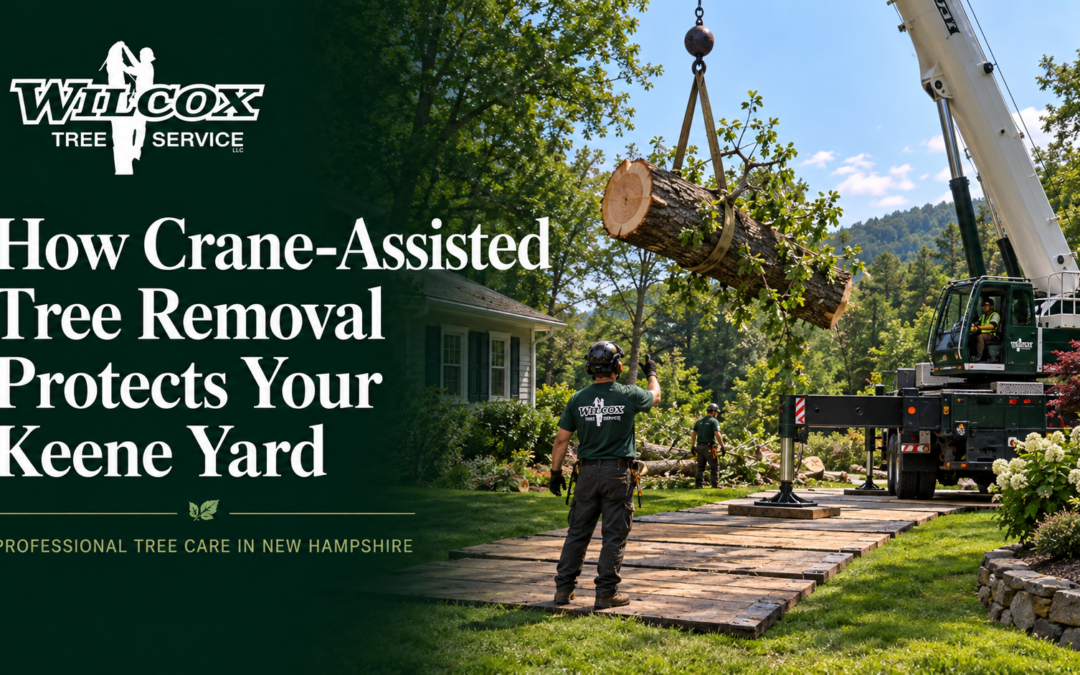
We brought a crane. The birch came out in clean sections, lifted straight up and over the fence to the truck waiting on the street. When the Petersons walked the yard afterward, the beds were intact, the path had not moved, and the lawn had a few footprints and little else.
That reaction is the whole reason we are writing this. If you love your yard and dread what a big removal might do to it, here is how a crane changes the story.
The Real Fear Behind Removing a Big Backyard Tree
If you are dreading a big tree removal, odds are the tree is not really the problem. The fear is about the yard around it. We want to say that plainly, because almost every homeowner who calls us about a large backyard tree is quietly worried about the same thing: the beds, the lawn, the patio, and everything else they have poured years of weekends into.
A tree standing alone in an open field is one thing. A tree standing in the middle of a landscaped yard is another. By the time a big birch, oak, or pine has been growing for decades, the yard has grown up around it. There are perennials that come back every spring, a lawn that finally filled in, maybe a paver patio or a stone wall that took a whole summer to build.
So the math in your head is not just how do we get the tree down. It is how do we get the tree down without wrecking the twelve other things I care about. That is a completely fair question, and it is the right one to ask before anyone starts cutting.
We have stood in a lot of Keene backyards having exactly this conversation. The tree is dead, dying, or leaning the wrong way, and it clearly has to go. The homeowner is nodding along, but their eyes keep drifting to the garden bed three feet from the trunk. That bed is the real conversation, and we get it. A tree can be replaced with a young one in an afternoon. A mature perennial border or a stone patio that took years to settle in is a different story, and we treat it that way.
How Standard Removal Can Tear Up a Keene Yard
To understand why a crane helps so much, it is worth being honest about how a big tree usually comes down without one. There is nothing wrong with traditional removal in the right spot. In the wrong spot, though, it asks a lot of your yard.
In a standard removal, a climber works up the tree and takes it down in pieces. Those pieces have to go somewhere, and mostly that somewhere is the ground. Limbs get lowered or dropped into a landing zone, then dragged across the yard to a chipper or a truck. Every drop lands with real weight, and every drag pulls brush and cut ends over whatever is underneath.
Then there is the equipment. Bigger jobs often mean a bucket truck, a skid steer, or a loader coming across the lawn to reach the tree and haul away the wood. New Hampshire ground is not always cooperative. In spring and after a wet stretch, our soil stays soft, and heavy tires or tracks leave ruts you will be staring at for months. Even in dry weather, repeated trips press the soil down and squeeze the life out of a lawn.
Add it up and a single tree can mean dozens of trips back and forth across your grass, brush dragged over your beds, and a heavy machine parked where your hostas used to be. None of it is careless. It is simply what the method requires when the only path for the wood is across your yard.
The damage is not always obvious on day one either. Sometimes it shows up weeks later, when the packed-down strip of lawn refuses to green up, or the crushed roots of a shrub give out the following season. That slow kind of damage is the part homeowners tend to forget to ask about, and it is the part that stings the longest.
How a Crane Lifts Instead of Drops
A crane flips the whole approach around. Instead of bringing the tree down to the ground in pieces and moving those pieces across your yard, we lift the pieces up and out. That one change is the heart of why crane-assisted tree removal is so much gentler on a landscaped property.
Here is roughly how it works. We set the crane where it can reach the tree, often from the street or driveway rather than the yard itself. A climber rigs a section of the tree. The crane takes up the weight of that section before the cut is finished, so the wood is held, not dropped. The climber makes the cut, and the crane lifts the piece straight up, clear of everything below, then swings it over to a staging area or right onto the truck.
Nothing crashes down. Nothing gets dragged. A limb that would have been lowered onto your garden and hauled across the lawn instead travels through the air and never touches the ground inside your yard. Section by section, the tree leaves overhead.
That is what people mean when they say a crane is precise. Every piece has a controlled path from the tree to the truck, and the operator and climber decide exactly where it goes. The birch in the middle of the Peterson yard came out that way, one held-and-lifted section at a time, while the beds sat untouched a few feet below.
Protecting Gardens, Lawns, and Hardscape
The features that usually take the beating in a removal are the ones a crane is best at sparing. Flower beds and vegetable gardens stay intact because no brush is dragged across them and nothing is dropped on top of them. Perennials that would have been flattened get to come back next spring like nothing ever happened.
The lawn benefits too. Without a machine crossing it over and over, and without heavy sections thudding down, the grass mostly deals with footprints and little else. Hardscape is a big one as well. Paver patios, stone walls, walkways, and edging are hard to replace and easy to crack, and a dropped log does not care how nice they look. Lifting the wood over them keeps them out of harm’s way entirely.
We also think about the things people forget until they are broken. Low landscape lighting, a good fence, an arbor, the nice shrubs by the patio. When the plan is to lift instead of drop, all of those stay off the casualty list.
Fewer Trips Across Your Property
The other quiet benefit is traffic. A traditional removal can mean a machine and a crew making trip after trip across your grass to move wood and brush. Each pass packs the soil down a little more and, on soft ground, carves another rut.
With a crane, most of that ground traffic disappears. The wood is going up and over to a single staging point or straight to the truck, so there is far less need to roll heavy equipment across the yard at all. Fewer trips means fewer ruts, less packed-down soil, and a lawn that bounces back in days instead of seasons. On a wet Keene spring morning, that difference is hard to overstate.
When Yard Protection Makes a Crane Worth It in Keene
A crane is not the right call for every tree. A small tree in an open corner of the yard usually does not need one. The place a crane earns its keep is exactly where yard damage is the real worry, and that describes a lot of Keene properties.
Landscaped backyards are the clearest case. If a big tree is standing in the middle of beds, lawn, and hardscape you care about, the damage of tearing all of that up is the thing you are really trying to avoid. Lifting the tree out over the top protects everything you built underneath it.
Septic systems and irrigation are another. A drain field or a run of irrigation lines does not like heavy equipment rolling over it, and repairs there are a headache nobody wants. Keeping machines off the yard keeps that buried plumbing safe. The same goes for wells and any soft, saturated ground where a loaded truck simply should not go.
Tight plantings and close quarters make the case too. When a tree is boxed in by a fence, a shed, a neighbour’s line, and a row of mature shrubs, there is no clean way to drop and drag anything. A crane reaches over all of it. And if you are weighing crane tree removal against the standard approach purely on yard damage, the landscaped-yard scenario is where the crane wins by the widest margin.
If your situation is more about keeping a healthy tree in good shape than removing it, that is a different conversation, and often the answer is regular tree trimming rather than removal at all. We are always happy to tell you honestly which one your tree actually needs.
How Wilcox Crane Service Protects Keene Properties
When you call us about a big removal, protecting the yard is part of the plan from the first walk-through, not an afterthought. We look at where the tree stands, where the crane can set up, and the exact path each section will travel on its way out. The goal is simple: get the tree down without your landscape taking the hit.
We start by finding the best position for the crane, usually off the yard entirely, on the street or driveway where the boom can reach over the property. We note what needs protecting: the beds, the patio, the irrigation heads, the good shrubs, the septic area. Then we plan the lifts so every piece has a clear route up and over those features to the truck.
During the job, the climber and the crane operator work as one team. The operator carries the weight, the climber makes the cut, and the section lifts away under full control. We keep the ground crew and equipment off the lawn as much as the site allows, because every trip we do not take is one less mark on your yard.
Cleanup matters just as much to us. When the wood is down and loaded, we clear the brush, rake out the debris, and leave the site tidy. If there are a few footprints or a scuffed patch, we tell you straight and help you sort it out rather than hoping you do not notice. Our aim is for you to walk the yard afterward and be a little surprised at how normal it looks, the way the Petersons were.
We run our own crane and crew as Wilcox Crane Service, so the planning and the lifting are handled by the same people who care whether your garden survives. You are not stuck coordinating between a tree crew and a rented crane that showed up cold and does not know your property. It is one team with one plan for your yard. That also means the person sizing up your beds and shrubs on day one is the same person calling the lifts on removal day, so nothing gets lost between the estimate and the work.
Protect your landscaping during a big removal. Call Wilcox Tree Service at 603-903-8624 for your Keene property.
Frequently Asked Questions
- Will removing a big tree damage my Keene yard?
It can, if the tree comes down the traditional way in a tight or landscaped spot, because limbs get dropped and dragged and heavy equipment crosses the lawn. That is exactly the risk a crane is built to reduce. By lifting the tree out in sections instead of dropping it, most of the beds, lawn, and hardscape stay untouched.
- How does a crane protect landscaping during tree removal?
The crane holds each section of the tree before it is cut, then lifts that piece straight up and over your yard to the truck. Because nothing is dropped or dragged across the ground, gardens, walkways, patios, and grass are spared the usual beating. The wood travels overhead instead of across your landscape.
- Is crane removal better for a yard with gardens and irrigation?
Yes, that is one of the best cases for it. Gardens, irrigation lines, and septic areas all suffer when heavy equipment rolls over them, and a crane keeps that traffic off the yard. Lifting the tree out over the top protects both the plantings you can see and the lines buried underneath.
- Does a crane keep heavy equipment off my lawn?
In most cases, yes. We usually set the crane up on the street or driveway rather than the grass, and the wood goes up and over to the truck instead of being hauled across the yard. That means far fewer trips with heavy machines, which is what causes the ruts and packed-down soil in our soft New Hampshire ground.
- Can Wilcox Crane Service remove a tree in the middle of my Keene backyard?
That is one of the situations a crane handles best. A tree surrounded by beds, fencing, and hardscape has no clean path for dropping and dragging, but a crane can reach over all of it and lift the tree out piece by piece. We plan the setup and the lift path so the tree in the middle of your yard leaves without taking your landscape with it.
- How much of my yard is disturbed during a crane removal?
Usually far less than people expect. Because the crane sits off the yard and the sections are lifted overhead, most properties come through with little more than some footprints and maybe a scuffed patch or two. We clear the brush and debris before we leave and point out anything that needs attention, so you know exactly what you are looking at.