
Trees can recover from storms, droughts, and many diseases. What they often can’t recover from is repeated bad pruning. Poorly-executed trimming over several years can kill trees that would have lived another century. Here are the most common mistakes we see at Wilcox Tree Service — and why they’re so damaging.
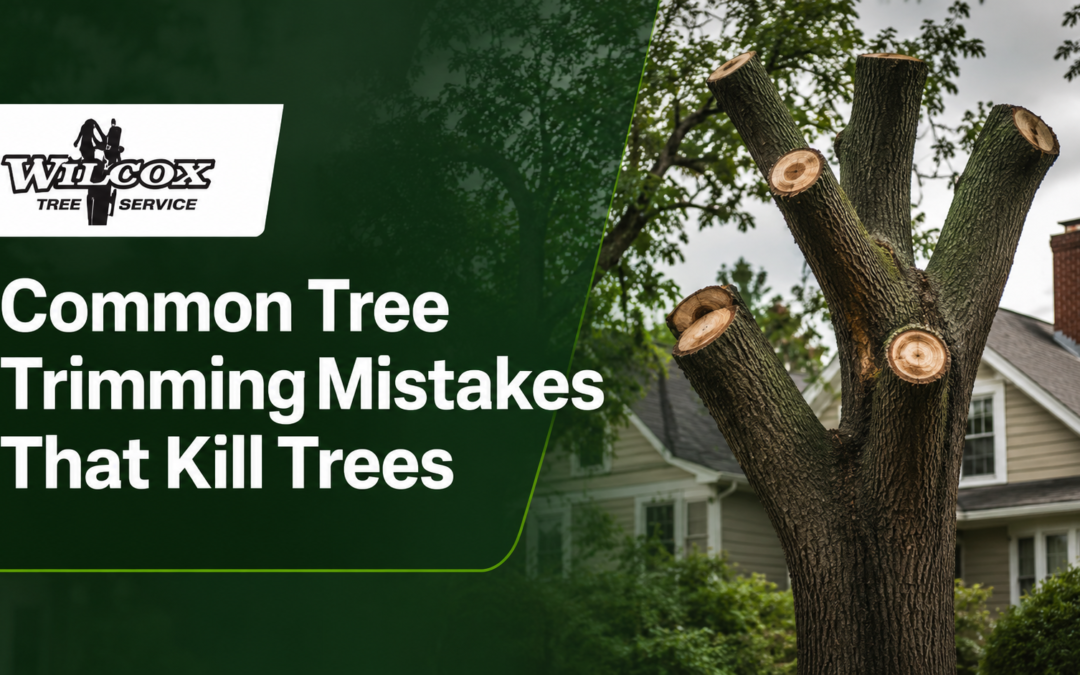
Mistake 1: Topping
What it is: Cutting all main branches horizontally at the same height to reduce tree size.
Why it’s bad: – Removes 50%+ of leaf surface at once – Triggers rapid, weakly-attached “watersprout” regrowth – Exposes inner bark to sunscald – Creates large wounds that invite decay – Destroys the tree’s natural form permanently
What to do instead: Proper crown reduction (see post above) — cutting back to lateral branches, no branch reduced more than 1/3.
Mistake 2: Lion’s Tailing
What it is: Stripping all the interior branches of a tree, leaving only foliage at the branch tips.
Why it’s bad: – Shifts all weight to the ends of branches – Dramatically increases failure risk in wind – Removes the tree’s natural shock-absorbing interior growth – Stresses the tree with excessive canopy loss
What to do instead: Gradual, distributed thinning throughout the canopy.
Mistake 3: Over-Pruning in One Visit
What it is: Removing more than 25% of live canopy in a single pruning.
Why it’s bad: – Triggers defensive regrowth that’s structurally weak – Stresses the tree, reducing disease resistance – Can kill newly-exposed interior branches through sunscald – Delays recovery for years
What to do instead: Spread heavy pruning over 2–3 visits in successive years.
Mistake 4: Flush Cuts
What it is: Cutting a branch flush with the trunk (no collar remaining).
Why it’s bad: – Removes the branch collar, which contains the tree’s natural wound-sealing tissue – Creates wounds that never properly seal – Invites decay directly into the trunk – Can girdle the trunk over time
What to do instead: Cut at the branch collar — leave the slight swelling at the branch base intact.
Mistake 5: Stub Cuts
What it is: Leaving a long branch stub instead of cutting at the collar.
Why it’s bad: – The stub dies back to the collar anyway – Creates dead wood pockets that host disease – Delays proper healing – Looks bad
What to do instead: Cut at the collar, not 6 inches out from it.
Mistake 6: Pruning at the Wrong Time
What it is: Heavy pruning during active growth, peak sap flow, or disease transmission seasons.
Why it’s bad: – Wastes stored energy the tree needs for leaf-out – Open wounds bleed sap in spring – Some diseases (oak wilt) spread through fresh cuts – Wounds heal slower during certain periods
What to do instead: Follow species-specific timing — see our best time for tree trimming post.
Mistake 7: Painting Over Wounds
What it is: Applying wound paint, tar, or sealants to pruning cuts.
Why it’s bad: – Modern arboriculture has shown wound paint slows rather than speeds healing – Traps moisture against the wound – Can actually promote decay
What to do instead: Nothing. Clean cuts at the collar are the tree’s best defense. The tree seals itself.
Mistake 8: Ripping Cuts on Large Branches
What it is: Making a single top-down cut on a heavy branch, which causes the branch to break and rip bark down the trunk.
Why it’s bad: – Tears bark well below the cut line – Creates long, jagged wounds that take years to heal – Can expose the trunk to decay
What to do instead: The three-cut technique: undercut first, top cut second (away from trunk), then clean cut at the collar.
Mistake 9: Improper Hedge Shearing
What it is: Flat-topping and hard-squaring hedges year after year.
Why it’s bad: – Only outer 2” of the hedge has green growth; inner wood becomes dead stubble – Creates hedges that are impossible to restore once they get bare – Kills bottom branches from shading
What to do instead: Wedge-shaped hedge profile (wider at the bottom) with periodic hand-pruning to maintain inner growth.
Mistake 10: Hiring Without Vetting the Contractor
What it is: Choosing a contractor without verifying qualifications, insurance, or pruning technique.
Why it’s bad: – Inexperienced crews may use improper techniques – Poor pruning can create lasting structural damage – Uninsured operators can transfer liability to the homeowner
What to do instead: Verify insurance, read specific reviews, ask about pruning technique, and confirm the scope of work in writing.
Get Pruning Done Right
At Wilcox Tree Service, our team is trained in proper arboriculture technique on every job. Call 603-363-8197 or request a free estimate.