
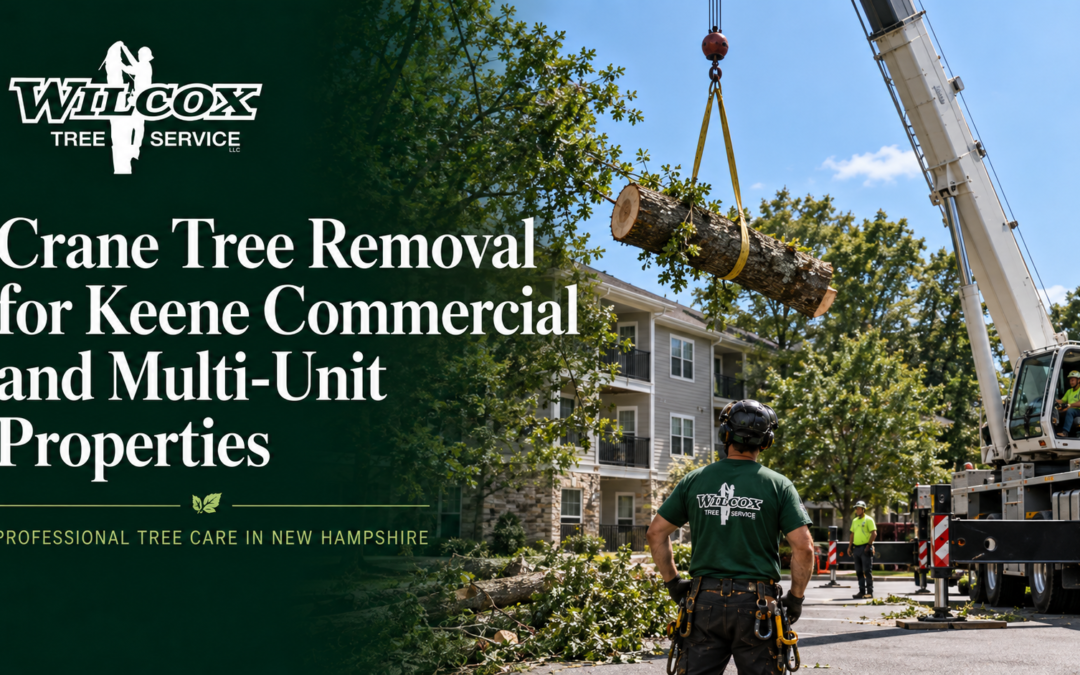
Karen Doucette had put it off for two summers. Three big pines stood in the narrow strip between two of the apartment buildings she manages off Winchester Street in Keene, and every fall they dropped limbs onto the walkways and the cars parked below. After a windy stretch in September, one of them cracked and started leaning toward a second-floor window. She could not put it off any longer.
Her worry was not really the trees. It was everything around them. The only way a normal crew could reach those pines was straight through the resident parking lot, and that lot was full by six most evenings. She pictured a week of blocked spaces, a stream of tenant complaints, and a lawn chewed up by heavy machines rolling back and forth between the buildings.
A friend who manages an office park across town told her to ask about a crane before she assumed the worst. So she called us.
We walked the property with her on a Tuesday. From one setup spot at the edge of the lot, a crane could reach over the first building, pick each pine apart in sections, and set the wood down in a staging area near the street. No machines squeezing between the buildings. No week-long shutdown. One planned morning, a handful of reserved spaces, and the trees would be gone.
That is the part that surprises a lot of property managers in Keene. A job that looks impossible on a busy site is often the exact job a crane was built for.
Why Big Tree Jobs Are Harder on a Working Property
The short version is simple. On a house lot, a tree removal only has to work around one family for a day. On a commercial or multi-unit property, that same removal has to work around a place that never really stops. Tenants come and go at all hours. Customers pull in and out of the lot. Deliveries show up on their own schedule. A leaning tree does not care about any of that, and neither does the weather that finally brings a weak one down.
That is what makes these jobs different. It is not that the trees are harder to cut. It is that the property around them cannot pause. A homeowner can move a car and keep the kids inside for an afternoon. A property manager cannot ask forty tenants to stay home, or tell a row of storefronts to close their doors while a crew works overhead.
Access is usually the pinch point. On many Keene commercial sites, the only way to reach the trees is straight across the parking lot that everyone depends on. Block that lot for days and you have created a second problem bigger than the tree itself. Add in fire lanes that have to stay clear, spaces reserved under accessibility rules, and dumpster and delivery access, and the puzzle tightens fast.
So the real goal on a working property is not just getting the tree down. It is getting it down with the least possible disturbance to the people who live, work, and shop there. That single goal is what points so many of these jobs toward a crane.
The Access and Downtime Problem on Keene Commercial Sites
Walk almost any commercial property in Keene and the same challenge shows up. The trees that need attention are rarely out in the open where a truck can pull right up to them. They are tucked between buildings, planted in landscaped islands in the middle of the lot, or lined along a boundary where a fence, a sidewalk, or a neighbor sits just beyond. Reaching them the old way means dragging equipment across ground that is already doing another job.
Parking is the heart of it. For an apartment complex, those spaces are effectively part of the tenants’ homes, and losing them for a week starts a run of complaints that lands right on the property manager’s desk. For a retail plaza or an office park, the lot is tied straight to business. Fewer spaces can mean fewer customers and frustrated staff. So the question is never only how do we get the tree down. It is how do we get it down without taking the parking hostage.
Traffic through the site adds another layer. People move through these properties all day, on foot and in cars, and most of them are not looking up. A removal that lowers heavy limbs over a driveway or a walkway has to account for every one of them. That usually means spotters, temporary barriers, and a lot of stopping and starting, all of which stretches the job out and raises the odds of a close call.
Then there are the work windows. Many commercial sites really only have a few quiet hours to give. Early morning before a store opens. Mid-morning after an apartment lot empties out for the workday. A weekend for an office park that sits still on Saturday. A method that drags a big removal across several days simply will not fit inside those openings. The less time the work takes, the better it fits the narrow slots a busy property can actually spare.
How a Crane Shortens Time on Site
A crane changes the math on a commercial removal because it changes where the work happens. Instead of a crew climbing and lowering each piece slowly from inside the canopy, the crane holds a section, the cut is made, and the wood lifts straight up and out to a staging area in one smooth move. Big pieces travel over the site rather than through it, and they land exactly where the crew wants them.
That overhead reach is what compresses the timeline. One good setup spot can often serve a whole cluster of trees, so the crew is not tearing down and rebuilding their position over and over. The lifts are quick and deliberate. What might take a ground crew the better part of a week can frequently be handled in a single planned window, which is exactly what a working property needs. If you want the full picture of how this works, our crane tree removal in Keene service page walks through it in more detail.
There is a safety dividend too. Keeping people out of a compromised tree, and pulling weight up and away from buildings, cars, and walkways, lowers the risk to everyone on site. Fewer hours spent overhead and fewer heavy pieces swinging through tight spaces mean fewer chances for something to go wrong on a property full of people.
Removing Trees Between Buildings
The trees that give property managers the most grief are the ones jammed into spaces you can barely walk through. The narrow gap between two apartment buildings. The strip behind a store. The corner where one wing meets a courtyard. There is no room to bring a bucket truck or a big machine in beside them, and dropping limbs by hand into a space that tight is slow and nerve-wracking.
This is where reaching from above earns its place. From a setup point out in the lot or on the street, a crane can lift right over a rooftop and pick a tree apart section by section without any heavy equipment ever going between the buildings. The wood rises clear of the walls, clears the gutters and windows, and swings out to open ground. Siding stays unscratched, walkways stay open, and the tenants a few feet away barely notice beyond the sound of the work.
Reopening Lots and Access Quickly
The footprint of a crane job is smaller than most people expect. Rather than spreading equipment and debris across the whole property, the work stays concentrated around the crane, the staging area, and a marked drop zone. Everything else can usually stay open, kept safe with cones and a ground crew guiding traffic around the active area.
That tight footprint is what lets a lot come back quickly. Because the removal itself moves fast, the section you close in the morning is often open again by afternoon. Our crew cleans as we go, hauls the wood out of the staging area, and hands each part of the site back as soon as it is clear. For a property that lives and dies by its parking and access, getting those spaces returned the same day is the whole point.
Property Types in Keene That Benefit Most
Not every tree needs a crane, but certain kinds of properties run into the situation again and again. What they share is a mix of big trees, tight access, and a lot to lose when the site shuts down. Around Keene, a few types come up more than the rest.
Apartment and condo complexes are near the top of the list. Buildings sit close together, mature trees fill the gaps and the edges, and every parking space belongs to somebody who expects it to be there. When a large tree between two buildings starts dropping limbs or leaning the wrong way, there is rarely a clean path to reach it from the ground, and there are always residents to work around.
Office parks bring their own version of the problem. Landscaped islands and buffer strips that were planted years ago with small trees are now full of tall, heavy specimens, often right in the middle of the parking field or along the entrance drive. The businesses there need the lot open during the day and cannot have their entrances blocked, so a fast, contained removal matters a great deal.
Retail plazas and shopping centers depend on visible, easy parking, and losing a chunk of it hurts every tenant at once. A crane keeps the closed area small and the timeline short, which keeps the storefronts open and the customers coming. Institutional sites round out the group. Schools, churches, medical offices, and municipal grounds all pair steady foot traffic with a low tolerance for hazards, and they tend to value the quiet, controlled nature of an overhead removal near occupied buildings. Many of these same properties also call us for straightforward tree removal service in Keene when a crane is not needed, so the plan always starts with what the specific tree and site actually require.
How Wilcox Tree Service Handles Keene Commercial Removals
Every commercial job we take starts with a walk of the property, not a quote over the phone. We want to see how your site actually works. Where the tenants and customers move, when the lot is busiest, where deliveries and fire lanes run, and where a crane can set up without getting in anyone’s way. The tree is only half the picture. The property around it decides most of the plan.
From there we build the removal around your operations. If mornings are quiet, we start early. If your lot only empties midday, we work then. We map out exactly which spaces we need and for how long, so you can give tenants or staff real notice instead of a vague warning taped to a door. The goal is a plan you can hand to the people who use the property and have it actually hold up.
On the day of the work, the lifts stay slow and deliberate even when the pace feels quick. Our crew makes each cut with the crane already holding the weight, so nothing drops, nothing swings toward a building, and every section follows a planned path out to the staging area. A ground crew manages the drop zone and guides foot and vehicle traffic around the active area the entire time.
When the trees are down, we clean up like it is our own property. Wood and debris come out of the staging area, the closed spaces get swept and reopened, and we walk the site with you to make sure it is left the way you need it for the next morning. If you are weighing a big removal on a commercial or multi-unit site, a quick call to our crane line at 603-903-8624 gets the conversation started, with no pressure attached to it.
Frequently Asked Questions
- Can crane removal minimize downtime on my Keene commercial property?
Yes, and that is usually the biggest reason a property manager calls us in the first place. A crane lets our crew work from one staging spot instead of dragging equipment all over your site. Because the trees come out in controlled lifts rather than being lowered slowly from inside the canopy, most jobs that would tie up a ground crew for several days wrap up in a single planned window. We reserve only the spaces we truly need and hand the rest of the lot back as we go, so your tenants and customers feel as little disruption as possible.
- How are trees removed from between apartment buildings?
Carefully, and mostly from above. When a tree is wedged in the narrow strip between two buildings, there is rarely room for machines to get in beside it. A crane solves that by reaching over the rooflines from a setup point out in the lot or the street. Our crew makes the cuts up in the tree, the crane lifts each section clear of the buildings, and the wood is set down in a staging area well away from the walls and windows. Nothing heavy has to squeeze between the structures, which protects siding, gutters, walkways, and the tenants living a few feet away.
- Can Wilcox Tree Service work around my business hours in Keene?
We plan the work around your schedule, not the other way around. For a retail plaza that fills up midday, that might mean an early start before the doors open. For an apartment complex, it often means a mid-morning window after residents leave for work and before they return. Tell us how your property runs, when the lot is busiest, and where deliveries come through, and we will build the plan around those facts. You can reach our crane line at 603-903-8624 to talk through the timing before anything gets scheduled.
- How long does a commercial crane removal keep a lot closed?
In most cases we do not close the whole lot at all. We block off only the section we need for the crane, the staging area, and a safe drop zone, then keep the rest open with cones and a ground person directing traffic. Because a crane speeds up the actual removal so much, the closed portion usually opens back up the same day, often within hours of the last lift. The exact timing depends on the number of trees, their size, and the layout of your site, and we give you a realistic window when we walk the property.
- What commercial properties benefit most from crane removal?
Any site where access is tight, the trees are large, and downtime is a real problem. That covers a lot of Keene. Apartment and condo complexes with buildings close together, office parks with landscaped islands, retail plazas that cannot afford to lose parking, and institutional grounds like schools, churches, and medical offices where safety and quiet matter. If a tree sits somewhere a truck and chipper cannot easily reach, or towers over a roof, a walkway, or a row of cars, a crane is often the cleanest way to bring it down.
- Does Wilcox Tree Service handle multi-tree removals on Keene commercial sites?
Yes. Multi-tree jobs are actually where a crane earns its keep. Once the crane is set and the plan is in place, taking down three or five trees in a row from the same staging spot is far more efficient than repositioning a ground crew for each one. We map out the order of removal, the lift paths, and the staging so the whole group comes out in as few closures as possible. Whether it is a cluster of storm-damaged pines or a full tree line along a property edge, we can plan the removal so your site keeps running.