
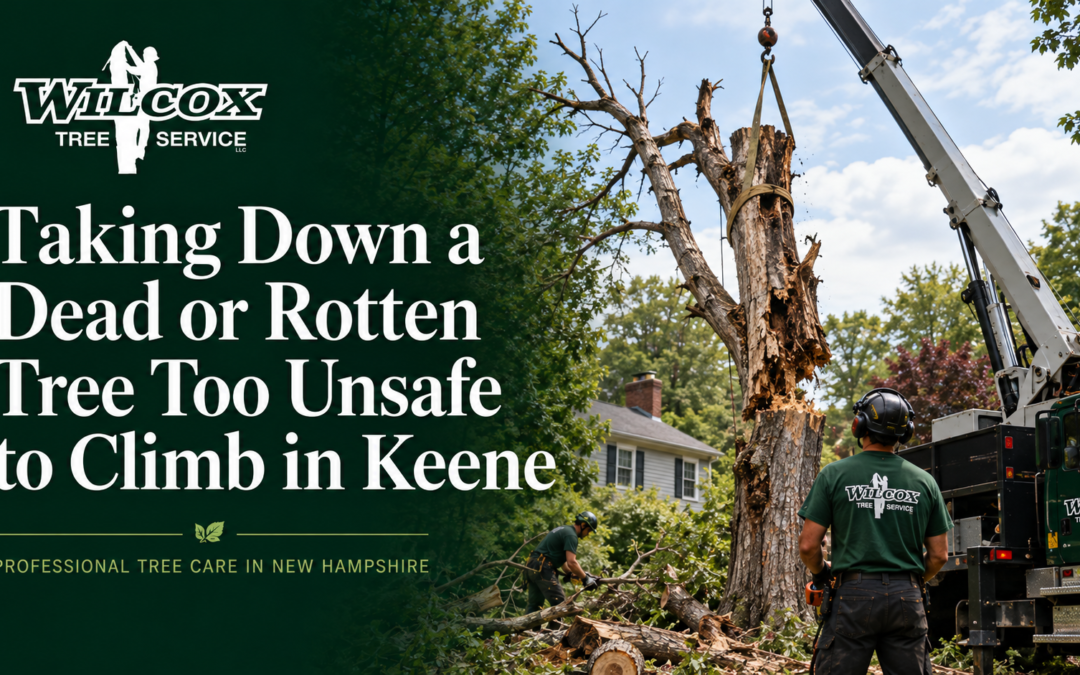
The dead oak in Peter and Sharon Brennan’s backyard had been a fixture on their Keene street for as long as either of them could remember. It stood off the corner of the deck, tall and broad, and even after it stopped leafing out a couple of summers back, it still looked every bit as solid as the day they moved in.
That was the trouble. Because it still looked strong, it was easy to keep putting off. The bark was mostly in place. The trunk stood straight. From the kitchen window it read as a big, sturdy tree that simply was not green anymore, and the Brennans figured there was no rush to deal with it.
When they finally had someone come out to look, the visit did not take long. He walked up, knocked hard against the trunk, and stopped. The sound that came back was not the dull thud of solid wood. It was hollow, almost like a drum.
That one sound told the whole story. The heartwood inside that oak was long gone, eaten away by years of quiet decay behind bark that still looked fine. Whatever was left was a shell, and a shell cannot be trusted to hold a person’s weight.
Sharon had assumed the tree would come down the way she had seen other trees taken apart, with a climber going up on a rope and lowering it piece by piece. That was the one thing that could not happen here. No one was going to set a climbing line in a trunk that hollow.
We hear this story often at Wilcox Tree Service. A dead tree that still looks solid from the ground is very often the one you can least afford to trust, and figuring out the safe way to take it down starts with accepting that no one should ever climb it.
The Tree That Looks Solid but Cannot Hold Weight
Here is the part most Keene homeowners want first. A dead or hollow tree can look completely solid from the outside and still be far too weak to hold a climber’s weight. The way a tree looks and the strength it actually has are two separate things, and on a dead tree they can drift a long way apart.
A living tree carries its strength in the wood just under the bark and in the sound core at its center. When a tree dies, or when decay works its way into the trunk, the outer shape can hold for a surprisingly long time. Bark stays put. The outline of the trunk keeps its form. From twenty feet away, and even from right up close, the tree can still look like it has years of life left in it.
Underneath that intact surface, though, the wood may be crumbling, hollow, or soft enough to push a screwdriver into. Decay does its work out of sight, from the inside out, so the last thing to change is the part you can actually see. By the time a dead tree finally looks dangerous from the ground, it has usually been dangerous for quite a while.
This gap between how a tree looks and how strong it really is drives everything that follows. A tree you would happily walk under, and might even think about climbing, can be a trunk that would fail the moment someone put real weight on it. Let me walk through what internal rot actually does, why climbing a tree like that is so risky, and how a dead tree gets taken down safely when no one can go up it.
What Internal Rot Does to a Keene Tree’s Strength
A healthy tree is constantly repairing itself. It lays down new wood every year, seals over small wounds, and pushes back against the fungi and moisture that are always trying to get in. That ongoing upkeep is a big part of what keeps a living tree strong enough to climb and work in.
A dead tree does none of that. Once it stops living, the repair work stops with it, and the only process left is decay. Fungi move in through wounds, broken limbs, and the root collar. Water follows every crack and settles there. Here in the Monadnock Region, our long wet springs and the constant freeze and thaw through winter push that decay along faster than a lot of people expect. A tree that died a couple of seasons ago can be much further gone inside than its owner realizes.
As the decay spreads, the tree loses the very thing a climber depends on, which is wood that will hold under load and behave in a predictable way. Sound wood flexes, grips a fastener, and carries weight. Rotted wood crushes, tears, and gives way. The strength that once made the tree safe to work in drains out of it long before the tree finally comes apart on its own.
Hollow Trunks and Failing Wood
A lot of decay starts at the center of the trunk, in the older heartwood, and works its way outward. That is why a tree can be hollow in the middle while the outer ring of wood and the bark still look normal. The tree may even keep pushing out a few leaves on some limbs while the core that holds everything up is quietly disappearing.
From the ground, the clues are easy to miss or brush off. Mushrooms or shelf fungus growing on the trunk or around the base. Bark falling away in patches. Woodpecker holes, which often mean the birds are finding insects in softening wood. A hollow or papery sound when the trunk is knocked. Small piles of sawdust-like material at the foot of the tree. Any one of these can mean the inside is not what the outside is advertising.
The hard truth is that you cannot measure how much sound wood is left just by looking at the outside. Two dead oaks standing side by side in the same Keene yard can be completely different inside, one still fairly firm and one nearly hollow, and from the driveway they can look identical. That uncertainty is exactly why a dead trunk is not something to gamble a climber’s life on.
Why Climbing a Dead Tree Is So Dangerous
Climbing a tree and taking it apart from up in the canopy is built on one assumption, that the tree will hold. The climber’s rope is anchored to the tree. The tie-in point, the limbs used for footing, and the trunk itself all have to carry weight, absorb shock, and stay put while the work goes on. On a healthy tree, sound wood makes all of that dependable.
On a dead or rotten tree, every one of those assumptions is in question. An anchor point set in decayed wood can tear out under load. A limb that looks fine can snap the instant a climber trusts it. The top can fail where the trunk has gone hollow. And the forces involved in dismantling a tree, the pulling, the shock loading, the weight swinging as pieces are cut, are exactly the kind of stress that finds every weak spot rotted wood is hiding.
There is no safe way to test your way up a trunk like that, because the failure does not announce itself. It happens all at once, with a person tied into the very tree that is giving way. That is why the honest answer for a dead tree too far gone is a simple one. Nobody climbs it. The whole job has to be done another way.
How a Crane Removes a Tree No One Should Climb
If no one can safely go up the tree, the weight has to be handled from outside it. That is exactly what a crane does. Instead of a climber ascending a failing trunk and lowering pieces on a rope, a crane reaches in from a safe position, takes hold of a section, and lifts it away while the crew stays clear of the tree itself.
The sequence is what makes it safe. A cable from the crane is set on the section that is going to be removed. A worker makes a single controlled cut from a safe spot, often from an aerial lift bucket parked beside the tree rather than in it, or from the ground. The crane then carries that piece up and out over the yard and sets it down in a clear drop zone. No one ever has to trust the rotten wood to hold them, because the crane, not the tree, is bearing the load the entire time.
This is a big part of why crane-supported removal has become the go-to method for dead and hollow trees around Keene. It keeps people off a trunk that cannot be trusted. It lets heavy pieces be lifted cleanly over a roof, a driveway, or a fence instead of being dropped into a tight space. And it takes a lot of the guesswork out of where things are going to land, because each piece is held and placed on purpose rather than cut and dropped.
For trees that are too unsound to climb, our crew leans on this approach regularly, and it is where crane service for tree removal in Keene, NH earns its keep. A dead tree standing close to the house is the exact situation a crane is built for, because it removes any need to put a single person in a tree that has already proven it cannot be trusted.
When a Dead Tree Should Come Down Right Away in Keene
A common next question is how dangerous a dead tree really is, and whether it can just be left standing for a while. Some dead trees, well away from anything they could hurt, are not an emergency. But certain signs mean a dead or rotten tree has crossed into hazard territory and should come down soon rather than later.
Watch for large dead limbs hanging over the house, the driveway, the deck, or anywhere people and cars sit. Dead wood has no flex left, so it is the first thing to break and fall in a wind or a heavy snow. A trunk that has started to lean, or ground that is lifting on one side of the base, can mean the roots are failing along with the wood above. Mushrooms or shelf fungus low on the trunk and at the root collar often point to decay right where the tree most needs to be strong.
Big cracks, open cavities, and bark sloughing off in sheets are all signs the structure is breaking down. A dead tree standing near a power line is its own kind of urgent, and one that should never be approached. And any dead tree close enough to reach the house if it fell deserves a serious look, because a hollow trunk can give way in a storm that a sound tree would shrug off.
The reason to act while the weather is calm is control. A planned removal happens on a clear day, on your schedule, with the crew set up and the drop zones chosen ahead of time. A dead tree that fails on its own picks the worst possible moment, usually in the middle of a storm, and it takes the choice out of your hands. When a rotten tree is standing over something you care about, sooner is almost always safer than later.
How Wilcox Tree Service Removes Unsafe Dead Trees in Keene
When a Keene homeowner calls us about a dead or hollow tree, we start by coming out and reading the tree in person. We look at the trunk, the base, the root collar, and the limbs, and we check for the signs of decay that tell us how far gone the wood really is. The first thing we are trying to settle is how much sound wood is left and, from there, the safe way to take the tree down. On a trunk that cannot hold a person, that answer is almost always removal from outside the tree.
From there we plan the removal around keeping our crew off the failing wood. For the trees that are too unsafe to climb, that usually means crane-supported work, with Wilcox Crane Service lifting the trunk and limbs away in sections while nobody trusts their weight to the tree. Each piece is cabled, cut from a safe position, carried clear, and set down in a spot we picked in advance. The heavier and closer to the house the tree is, the more that method earns its place.
Then we clean up. A removal is not finished, the way we see it, until the wood is down, the debris is hauled or chipped, and your yard is back to something you can walk across. We handle this kind of hazardous tree removal in Keene, NH all over the area, and the goal never changes, which is getting an unsafe tree down without anyone getting hurt and without tearing up the property around it.
The other thing we will always do is give you a straight answer. If a dead tree is far enough from anything to wait, we will tell you. If it is a real hazard that should not stand through another storm, we will tell you that too. You can reach our general line at 603-363-8197, and for crane-specific questions, Wilcox Crane Service is at 603-903-8624. The Brennans, for what it is worth, made the right call by having their oak looked at before anyone climbed it, and their hollow tree came down without a single person ever setting foot in it.
Have a dead or hollow tree in Keene? Call Wilcox Tree Service at 603-363-8197 before anyone climbs it.
Frequently Asked Questions
- Why can a dead tree be too unsafe to climb in Keene?
Because climbing depends on the tree holding a person’s weight, and a dead tree has lost the sound wood that makes that possible. Decay hollows out the trunk and weakens the limbs and the points a climber would anchor to, so an anchor can tear out or a limb can snap under load with no warning. The wood does not give a reliable sign before it fails. When a trunk is that far gone, the safe answer is to keep everyone out of it and take the tree down from outside instead.
- How do I know if my tree is rotten inside?
You often cannot tell for certain from the ground, but there are strong hints. Mushrooms or shelf fungus on the trunk or around the base, bark falling away in patches, woodpecker activity, cracks or open cavities, and a hollow sound when the trunk is knocked all point to decay inside. Fine sawdust-like material at the foot of the tree is another sign. Any of these are worth a closer look, because the inside of a trunk can be far weaker than the outside suggests. A hands-on assessment is the only sure way to know how much sound wood is really left.
- Is a hollow tree dangerous even if it looks solid?
It can be, yes. Decay usually starts in the center of the trunk and works outward, so a tree can be hollow inside while the bark and outer shape still look normal. That intact surface is exactly what fools people. The outer shell holds the tree’s shape long after the core that carries the load has broken down, which means a tree you would happily walk under can still be too weak to climb or to trust in a storm. Looking solid is not the same as being solid.
- How is a dead tree removed if no one can climb it?
The weight is handled from outside the tree, most often with a crane. Instead of a climber going up and lowering pieces on a rope, a crane reaches in from a safe position, holds a section while a single controlled cut is made, and then lifts that piece away and sets it down in a clear spot. No one ever puts their weight on the failing wood, because the crane carries the load the whole time. It is the standard way we take down trees that are too rotten or hollow to climb.
- Should a dead tree be removed right away in Keene?
It depends on where it stands. A dead tree well clear of anything it could damage is not always an emergency, but one near the house, the driveway, a power line, or a spot where people gather should come down soon. Dead wood breaks first in wind and heavy snow, and a hollow trunk can fail in weather a healthy tree would handle easily. Taking it down on a calm day, on your schedule, is far safer than waiting for it to come apart on its own during a storm.
- Does Wilcox Tree Service remove dead and rotten trees safely?
Yes, this is a core part of what we do. We come out and assess how far the decay has gone, then plan a removal that keeps our crew off the unsafe wood, using crane support to lift the trunk and limbs away in sections when a tree is too rotten to climb. We clear the debris when the work is done and leave your yard walkable again. You can reach Wilcox Tree Service at 603-363-8197, or Wilcox Crane Service at 603-903-8624 for crane-specific questions.