
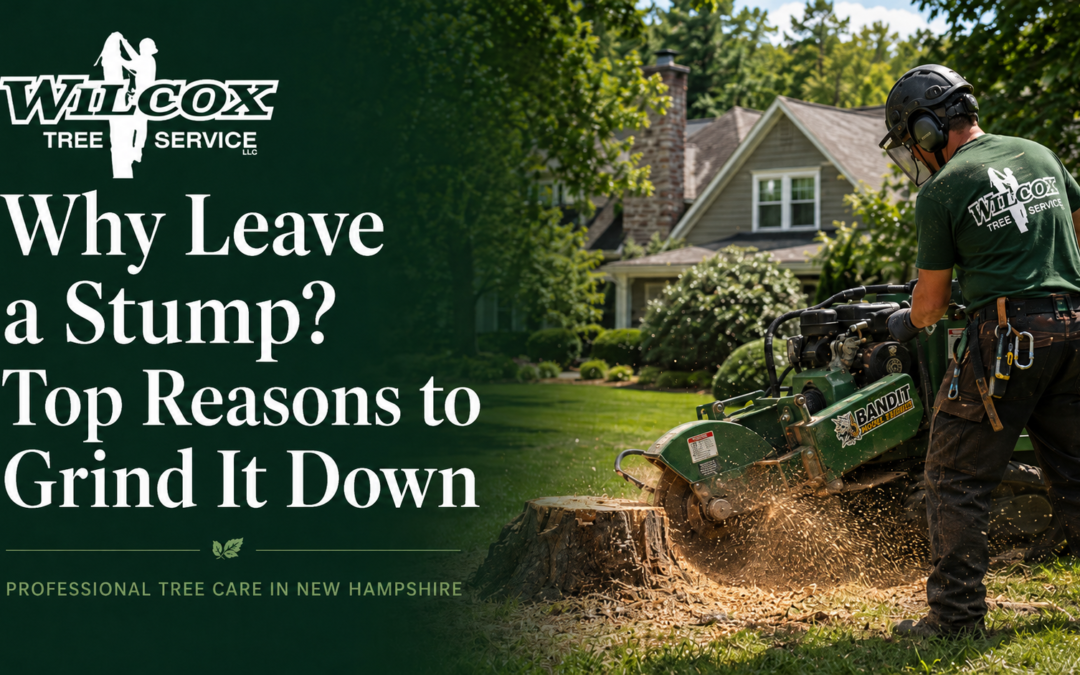
After a tree comes down, most homeowners face a decision: pay to grind the stump or live with it. Many leave them and regret it later. Tree stumps aren’t just cosmetic problems — they create ongoing maintenance headaches, safety issues, and pest problems. Here’s why Wilcox Tree Service recommends grinding almost every stump.
1. Stumps Are a Trip Hazard
A stump hidden in lawn grass is a silent ankle-sprainer. Kids running in the yard, guests walking the property at dusk, or just you with an armful of groceries — that stump doesn’t move. Every year, homeowner injury claims include stump trips.
2. Stumps Damage Lawn Equipment
Run a mower blade into a stump and you’ve bent or broken something expensive. Even a stump ground just to lawn level can catch blades. Complete grinding eliminates the hazard.
3. Stumps Sprout
Many species (willow, maple, popular, even some oaks) send up persistent new shoots from the remaining roots. These sprouts: – Look terrible – Require repeated mowing or cutting – Can grow into a new multi-stem tree if ignored – Drain resources from surrounding landscape
Grinding down to 6–12” below grade prevents most resprouting.
4. Stumps Attract Pests
Decaying wood hosts: – Carpenter ants — major structural threat if they then discover your house – Termites — same problem – Bark beetles and borers — can spread to healthy trees – Wasps and hornets — often nest in hollow stumps
5. Stumps Harbor Disease
Fungal pathogens (especially Armillaria root rot) persist in stumps and can spread via root grafts to nearby healthy trees. Grinding the stump reduces this disease reservoir.
6. Stumps Take Decades to Decay Naturally
A 20-inch diameter hardwood stump can take 15–30 years to fully decompose. That’s two decades of mowing around it, tripping over it, and watching it slowly rot. Grinding resolves it in an hour.
7. Stumps Waste Usable Yard Space
That 4-foot circle of stump-plus-mulch is real estate you can’t use for grass, garden beds, a fire pit, or anything else. Grinding and backfilling turns it back into yard.
8. Stumps Reduce Property Value
Buyers notice stumps. They signal deferred maintenance, raise questions about what trees came down and why, and often trigger inspection callouts. A clean yard sells for more.
9. Stumps Make Replanting Impossible
Want to plant a new tree where the old one was? Impossible with an intact stump. Grinding and soil preparation allows replanting.
10. Stumps Fail During Construction
Adding a patio, shed, driveway, or addition where a stump sits? You can’t build over it. Grinding removes the obstacle and saves contractor time (and cost).
The Case for Keeping a Stump (Rare)
There are limited scenarios where leaving a stump makes sense: – Deep in a woodlot where it has no impact – Used intentionally as wildlife habitat – Too close to a foundation to grind safely (rare) – The homeowner plans to use it as a feature (hollowed planter, etc.)
For most residential situations, grinding is the better choice.
What Stump Grinding Costs
- Small stumps (under 12” diameter): $75–$150
- Medium stumps (12–24”): $150–$300
- Large stumps (24–36”): $300–$500
- Very large (36”+): $500–$1,000+
- Multiple stumps at one visit: Per-stump discount
Scheduling with Your Tree Removal
If you have a removal scheduled, bundling stump grinding is often more affordable than scheduling separately. Let us know during the estimate.
Book Stump Grinding
Call 603-363-8197 or request a free estimate. We serve all of Keene, Westmoreland, and the Monadnock Region.