
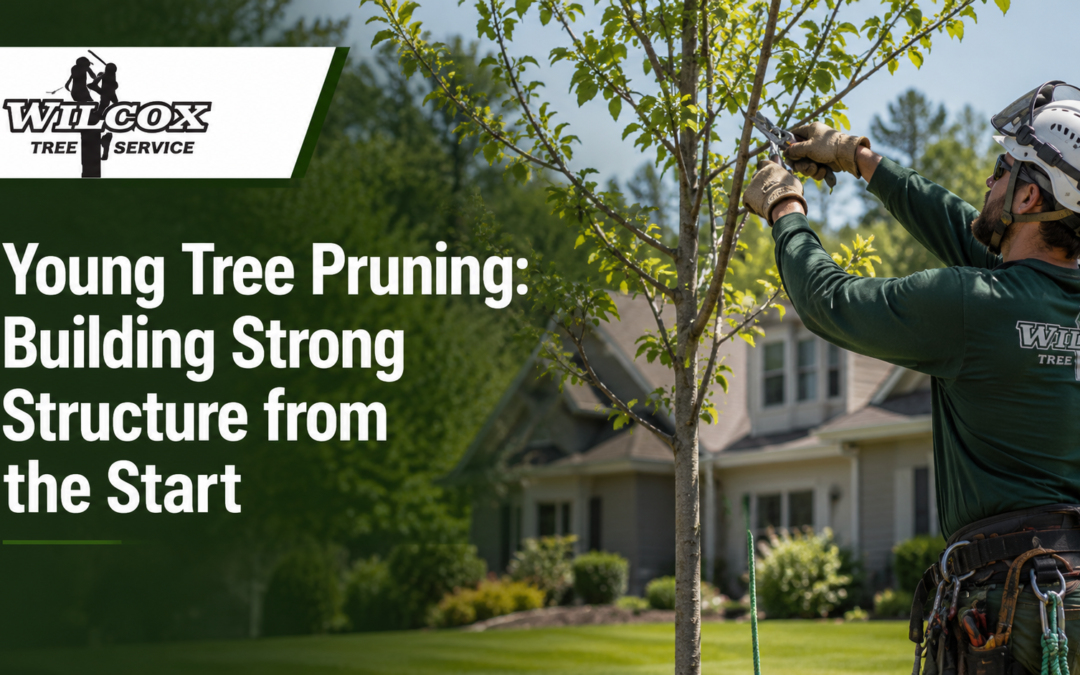
The structure of a mature tree is set in its first 10 years. The branches that become main leaders, the angles of scaffold branches, the height of the canopy — all decisions happen early. Pruning young trees correctly is the single highest-value investment you can make in your landscape’s future. Here’s the guide from Wilcox Tree Service.
Why Young Tree Pruning Matters
A mature tree with poor structure is expensive and often impossible to correct: – Weak branch unions develop into splitting trunks – Competing leaders become major structural weaknesses – Overcrowded canopies become maintenance headaches – Low branches become clearance problems
Most of these issues could have been fixed with 10 minutes of pruning in the tree’s first 3 years.
The Three-Year Formation Plan
Year 1 (post-planting): – Minimal pruning. Let the tree recover from transplanting. – Remove only dead, broken, or clearly diseased branches – Don’t remove healthy branches — the tree needs every leaf – Stake only if necessary, remove stakes within 12 months
Year 2: – Select scaffold branches. Identify 4–6 main branches well-spaced around the trunk – Remove obviously competing leaders – Remove crossing branches at their origin – Leave most small branches — they feed trunk development
Year 3: – Establish a central leader clearly. Remove secondary leaders competing with the main one – Develop scaffold branch spacing (vertical 12–18” between branches) – Start raising the canopy if clearance is needed – Continue removing structural problems early
Key Decisions Made in Year 1–5
Central Leader vs. Multi-Stem. Most shade trees benefit from a single dominant leader. Some ornamentals (river birch, some Japanese maples) are intentionally grown multi-stem. Decide early.
Scaffold Branch Selection. The 4–6 branches that will become the main framework should be: – Well-spaced vertically (at least 12” apart) – Distributed radially around the trunk – With wide angles of attachment (60–90° ideal) – Well below 1/2 the trunk diameter where they attach
Branch Angles. Narrow-angle branches (under 45°) have “included bark” — a weakness that will eventually split. Select wide-angle branches; remove narrow-angle competitors.
Common Young Tree Problems
Co-dominant Leaders. Two branches of equal size competing for dominance. Intervene early — reduce one before it grows too large. Waiting causes expensive structural problems at maturity.
Watersprouts. Fast-growing vertical shoots, often after transplant shock or damage. Remove them annually.
Included Bark. Bark growing between two branches instead of proper fusion. These junctions fail at maturity. Identify and correct early.
Girdling Roots. Not a pruning issue but often discovered during young tree care — roots wrapping around the trunk that will eventually strangle the tree. Corrective root pruning helps.
Stakes Left Too Long. Stakes should come off within a year. Tree ties left on create girdling wounds. Check young trees annually.
The “Less Is More” Rule for Young Trees
It’s tempting to shape a young tree aggressively. Don’t. Young trees need their leaves and small branches to fuel root development and trunk thickening.
Rule of thumb: no more than 10–15% of live canopy removed in one year during the first 3 years.
Save heavier corrective work for years 4–10, when the tree has established stronger roots.
Species-Specific Notes
Fast growers (silver maple, willow, poplar): Aggressive early pruning needed to prevent weak structure
Slow growers (oak, beech, hickory): Very light touch — mistakes are harder to recover
Conifers (pine, spruce, fir): Usually minimal pruning needed; preserve central leader carefully
Ornamentals: Follow species-specific rules — see our ornamental pruning post
When to Hire a Professional
For small trees under 10 feet, thoughtful homeowners can do young tree pruning themselves. Call us when: – Multiple young trees need establishment pruning – Valuable specimen trees that warrant professional care – Trees already showing structural problems – You’re unsure which branches are scaffolds
Invest in Your Trees’ Futures
The best time to plant a tree is 20 years ago. The second-best time is today — and the third-best time is right now to start pruning the trees you already have. Call 603-363-8197 or request a free estimate.