
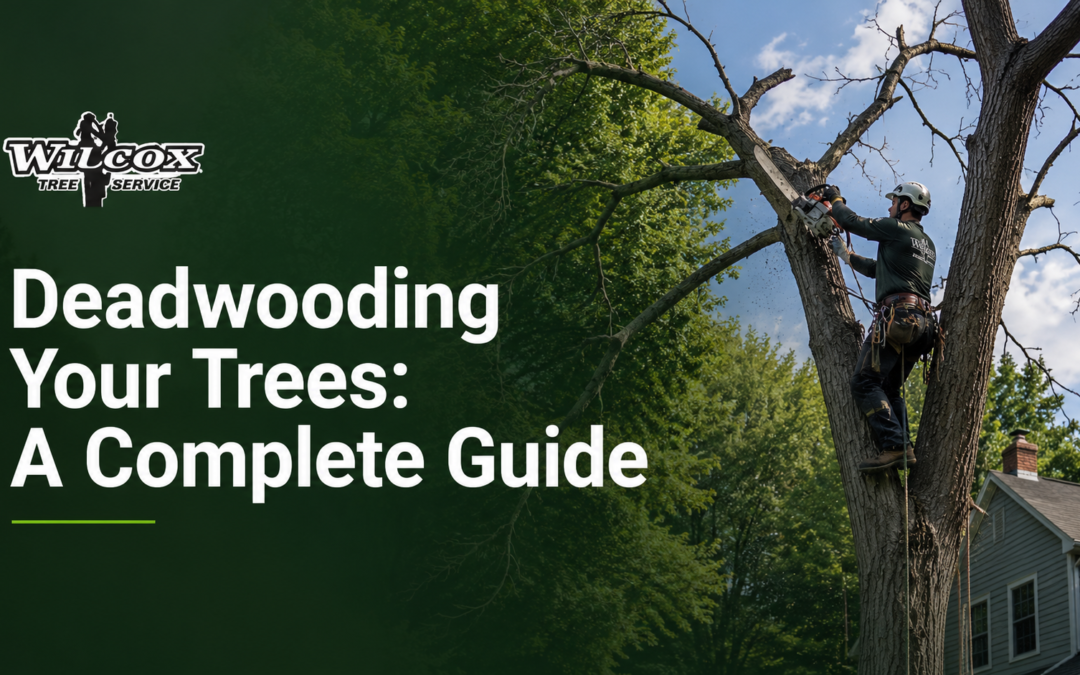
Deadwooding is the selective removal of dead branches from an otherwise healthy tree. It’s one of the most commonly requested pruning services — and also one of the most overlooked by homeowners who don’t realize their tree has dead wood until a branch drops into the yard. Here’s the complete guide to deadwooding from the tree care team at Wilcox Tree Service.
Why Trees Develop Dead Wood
Dead branches are a natural part of tree life. Causes: – Shading: Lower canopy branches die when upper growth blocks their light – Age: Older branches naturally expire as the tree redirects resources – Damage: Storm breaks, ice damage, or mechanical injury can kill specific branches – Disease: Fungal or bacterial issues can kill sections – Pest damage: Boring insects, cankerworm, etc. – Drought stress: Extended dry periods can kill outer branches
Most trees have some dead wood at any given time. The question is how much and where.
Why Deadwooding Matters
Safety. Large dead branches fall without warning. An unnoticed dead limb in a front-yard tree can injure a family member, kill a pet, or destroy a vehicle.
Tree Health. Dead wood hosts: – Decay fungi that spread to healthy wood – Insect pests like carpenter ants and bark beetles – Disease reservoirs
Appearance. Dead branches look obvious once you see them — and your neighbors and buyers notice.
Neighborhood Responsibility. A dead branch that falls on your neighbor’s property can create liability issues.
How to Spot Dead Branches
Look for: – No leaves during the growing season (while the rest of the tree is full) – No buds at the branch tips – Peeling, loose, or missing bark – Gray or black color while healthy branches are brown – Broken or cracked ends from past weather – Fungal growth (mushrooms or conks)
What Size Gets Removed?
Professional deadwooding typically targets dead branches over 1–2 inches in diameter. Smaller dead twigs are often left — they break off in wind events without damaging anything significant.
For high-risk locations (over your house, driveway, or regular activity areas), we may remove smaller dead material too.
How Often?
- Annually for large specimen trees near structures
- Every 2–3 years for standard residential trees
- After major storms — regardless of schedule
- Immediately when a large dead branch is spotted over a target zone
The Deadwooding Process
When our crew arrives: 1. Assessment — walk the tree, identify all targets 2. Entry — climb via rope or ascend in bucket truck 3. Systematic cutting — work outward from trunk, removing each dead branch at its collar 4. Controlled lowering — drop into safe zones or lower by rope 5. Inspection — check for additional concerns (fungal bodies, cavities, cracks) 6. Cleanup — chip branches, haul debris, rake lawn
Winter Advantages
Deadwooding is particularly efficient in winter: – Bare deciduous canopies make dead branches easy to spot – Frozen ground protects lawns from equipment – Less competition for scheduling
Combined Services
Deadwooding often combines well with: – Crown thinning (when the canopy is dense) – Crown raising (when lower branches need clearing) – Hazard pruning (when additional structural issues exist)
Combining compatible services in one visit can make the work more efficient and reduce repeat disruption to the property.
Don’t Wait for a Branch to Drop
Scheduled deadwooding is always safer and easier to plan than emergency response after a branch comes down. Call 603-363-8197 or request a free estimate.