
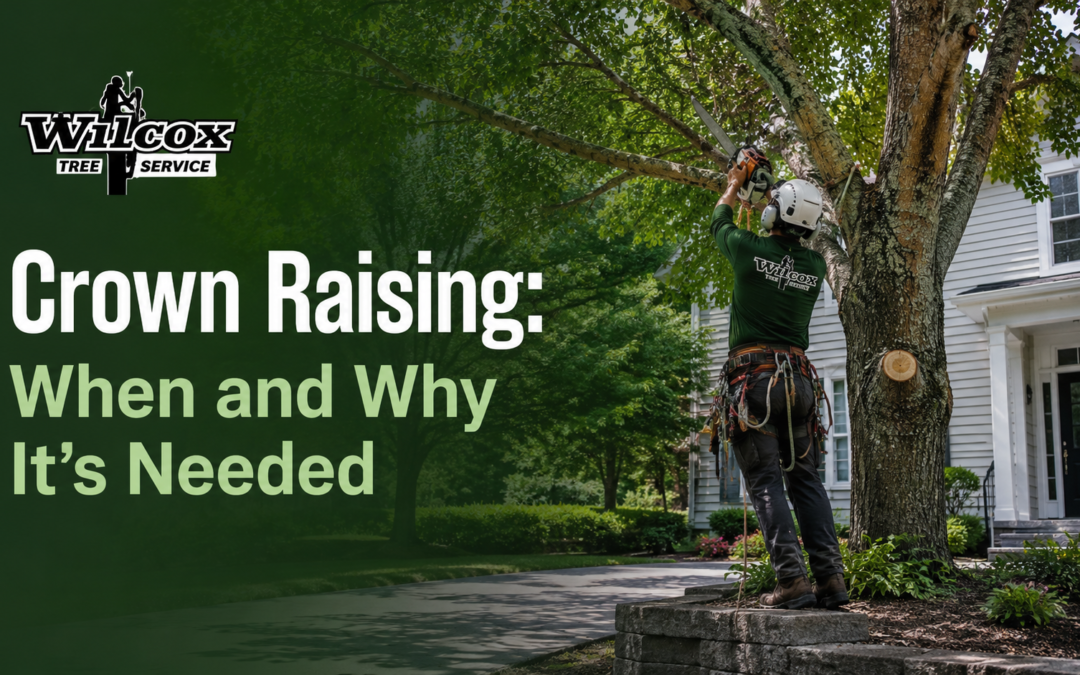
Crown raising — also called “crown lifting” — removes the lower branches of a tree to increase the vertical clearance beneath. It’s one of the most practical pruning services for residential properties, used when you need trees to share space with lawns, driveways, walkways, and structures. Here’s how Wilcox Tree Service approaches crown raising and when it makes sense for your property.
What Crown Raising Is
Crown raising means removing the lowest branches of the canopy to expose more of the trunk.
Typical goals:
– Pedestrian clearance: Lift to 7–8 feet over walkways
– Vehicle clearance: Lift to 12–14 feet over driveways
– Road clearance: Lift to 14+ feet over public roads
– Lawn clearance: Lift to 6–8 feet to allow mowing access
– Visibility: Open views while preserving the tree
When Crown Raising Is Appropriate
You probably need crown raising if: – Branches block your walkway, patio, or deck – Mowing around the tree is difficult or impossible – Vehicles scrape branches on the driveway – Low limbs block sightlines from windows or driveways – Lower branches are crowding your house
When Crown Raising Is NOT a Good Fit
- Very young trees: Lifting too early eliminates the lower branches that help thicken the trunk
- Already-lifted trees: Continuing to lift creates unbalanced, unstable structure
- Trees where appearance depends on low branches (weeping cherries, specimen pines)
- Stressed trees that can’t afford additional canopy loss
The Structural Rule
Industry guideline: the canopy should occupy at least 2/3 of the total tree height. A 30-foot tree should have a canopy starting around 10 feet up — not 20. Over-raising creates top-heavy, wind-vulnerable trees.
This is why experienced professionals will sometimes decline to raise as much as a homeowner requests. The short-term aesthetic isn’t worth the long-term structural risk.
Progressive Raising for Young Trees
For young trees, crown raising should happen gradually over multiple years: – First 5 years: Don’t raise at all — let lower branches help trunk development – Years 5–10: Light raising, removing only the lowest branches each year – Mature: Final raise to target clearance height
This produces a strong-structured mature tree with appropriate lift.
How Much Can Be Removed in One Visit?
No more than 25% of total canopy should be removed in any single pruning visit. For crown raising, this often means multiple visits over 1–3 years to reach target clearance without stressing the tree.
Technique Matters
Proper crown raising technique: 1. Cut at the branch collar — not flush with the trunk 2. Remove the lowest branches first — work upward only as needed 3. Maintain canopy symmetry — raising one side makes the tree lean 4. Preserve the central leader 5. Clean final cuts — no stubs, no torn bark
Crown Raising and Wind Loading
Raising the crown moves all the wind load higher on the tree, increasing leverage against the root system. Combined with an exposed trunk, this can increase failure risk in storms if overdone.
Wilcox’s approach: we raise only as much as needed for the specific purpose, never for generic “cleanup.”
Crown Raising Near Structures
When the goal is clearance from your house, we focus on: – Branches actively touching or rubbing the house – Branches within 3 feet of siding or roof – Branches growing under gutters or into eaves
Not every branch visible over your roof needs to come off — just the ones creating active problems.
Schedule Crown Raising
Call 603-363-8197 or request a free estimate. We’ll recommend the right amount of raise for your tree’s age and species.